AT A GLANCE
What you’ll learn
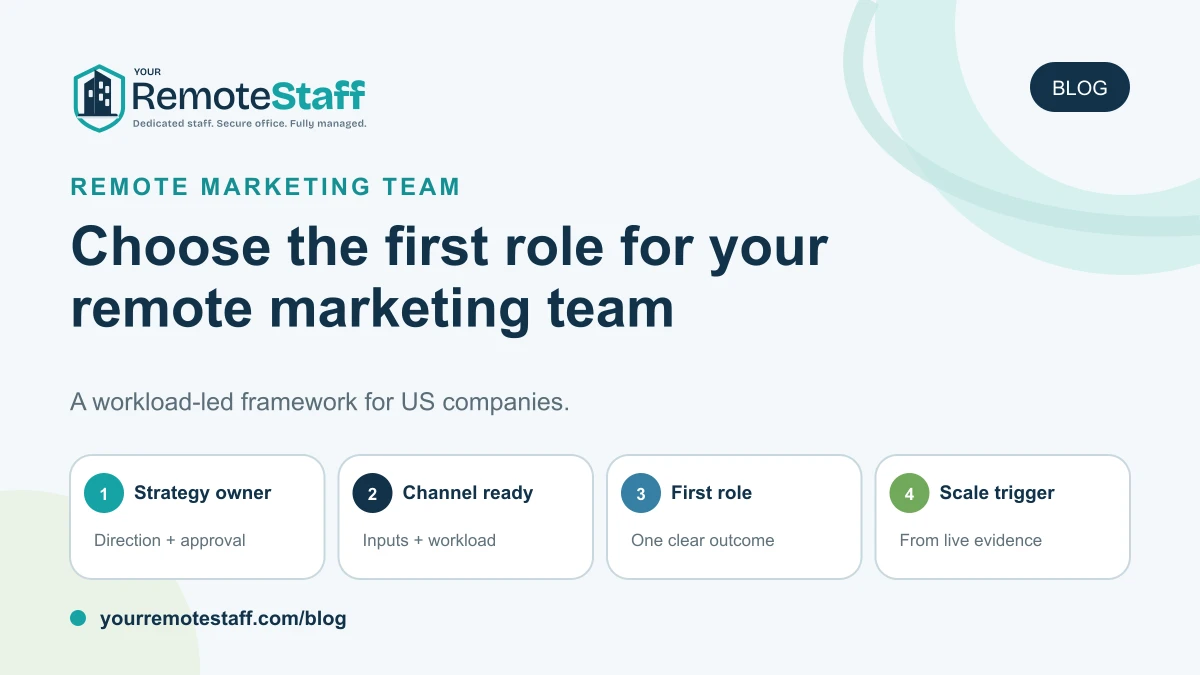
- Confirm who owns marketing strategy and approvals before hiring an execution role.
- Choose the first seat from a recurring channel bottleneck, not a generic marketing org chart.
- Verify the channel has usable inputs, review capacity, and enough work for a dedicated seat.
- Design account access, collaboration windows, and approval rules before the start date.
- Add the next role only when workload and queue evidence reveal a sustained constraint.
In this guide 15 sections
Start with the marketing constraint, not the job title
The first role in a remote digital marketing team should remove a recurring execution constraint that your company already understands well enough to direct. It should not be whichever title appears first on a generic marketing org chart.
That distinction matters because “marketing” can describe several different systems:
- Earning organic visibility through technical SEO, on-page work, and content planning
- Managing paid acquisition across search and social platforms
- Producing articles, landing pages, case studies, and campaign copy
- Running social publishing and community workflows
- Building email campaigns, automations, and lifecycle programs
- Growing authority through relevant outreach and partnerships
- Coordinating a modest mix of channels before any one channel needs deep specialization
One person cannot provide full specialist depth in all seven areas. The useful first-hire question is therefore not “Who can do all our marketing?” It is:
Which recurring marketing outcome has enough strategy, inputs, and measurable work to justify one accountable remote seat?
First decide: marketing leadership or execution capacity?
A dedicated remote marketer adds execution capacity. The seat does not automatically replace the person who chooses the market, offer, positioning, budget, channel strategy, or acceptable business outcomes. If nobody can make those decisions, establish marketing leadership before asking one specialist to invent the strategy and execute every channel alone.
Throughout this guide, a remote marketing seat means a dedicated professional working exclusively with your team—not a freelancer or shared resource. Your company directs campaigns, priorities, approvals, budgets, brand decisions, and performance expectations. In YourRemoteStaff’s office-backed model, we manage the agreed recruitment, workspace, hardware, IT, HR, payroll, attendance, and local-support layer around the seat.
The short answer by business situation
Use this matrix to identify the most plausible first role. It is a diagnostic starting point, not a universal hiring sequence.
| Your recurring constraint | Likely first remote role | What should already exist | Do not start here when |
|---|---|---|---|
| Several channels need steady basic execution, but none fills a specialist workload | Digital marketing specialist | Clear weekly priorities, one internal decision-maker, and realistic channel boundaries | You expect deep technical SEO, high-complexity paid media, and high-volume content from one seat |
| Organic search has a defined business role, but audits, on-page work, briefs, and measurement lack ownership | SEO specialist | A crawlable website, access to developers or CMS owners, subject expertise, and a content path | The offer and audience are still undefined, or the actual constraint is writing capacity |
| Meaningful paid campaigns are active or ready, but account structure, pacing, testing, and reporting lack daily ownership | PPC specialist | Approved budget, working conversion measurement, landing-page support, and fast commercial decisions | The company has not validated an offer or cannot approve budgets, creative, and landing-page changes |
| Strategy and briefs exist, but publishable copy is the sustained bottleneck | Content writer | Approved topics, subject-matter access, a review owner, brand guidance, and a publishing workflow | Nobody owns editorial strategy, factual review, distribution, or conversion paths |
| Social channels matter, but calendars, publishing, community responses, and reporting happen inconsistently | Social media manager | Defined audiences, brand voice, approved channels, content inputs, and escalation rules | The company expects social posting alone to solve an unclear positioning or demand problem |
| A real subscriber or customer lifecycle exists, but campaigns, segmentation, and automations lack ownership | Email marketing specialist | Permissioned contacts, an email platform, lifecycle events, offers, and data access | There is no meaningful list, lifecycle, or consent-aware operating process |
| SEO and content foundations exist, but relevant outreach and relationship development need focused capacity | Link building specialist | Quality content or assets, target criteria, approved outreach standards, and SEO ownership | The plan is based on indiscriminate volume, purchased placements, or no editorial value |
If more than one row appears to fit, compare which workload is both most commercially important and most ready to absorb full-time attention. A large backlog is not enough if the hire will spend most of the week waiting for strategy, approvals, creative, data, or technical support.
Review the complete set of digital marketing roles after identifying the constraint. The role catalog should confirm the decision, not make it for you.
Step 1: Name the person who owns marketing direction
Before recruiting, name one accountable person inside your company for:
- Target market and buyer definition
- Offer, positioning, and commercial priorities
- Channel budget and resource allocation
- Brand voice and claims
- Campaign and content approvals
- Website, product, sales, and creative dependencies
- Performance interpretation and trade-offs
- Access approval and incident escalation
In a founder-led business, this may be the founder. In an established company, it may be a marketing director, growth lead, or channel manager. In an agency, it may be an account strategist or delivery owner who translates client commitments into approved work.
The internal owner does not need to perform every task. They do need enough authority and context to answer questions such as:
- Which customer segment matters this quarter?
- Which offer can the channel promote?
- What claims can the company support?
- Which metric informs the next decision?
- Who can change the website, creative, product, or sales process?
- What should stop when a higher-priority campaign arrives?
Without that ownership, a remote hire can create activity—reports, posts, drafts, campaign changes—without a reliable path to business value. The problem is not distance. It is missing decision authority.
When the first hire should be a marketing leader instead
A head of marketing, fractional marketing leader, or qualified strategist may need to come first when:
- The company has not chosen a target segment or positioning
- Marketing and sales disagree about the offer or lead definition
- There is no channel strategy or budget
- Every campaign starts from a blank page
- Nobody can evaluate specialist recommendations
- The role is expected to set company strategy, manage several functions, and execute all of them
That leader may later design and direct a dedicated remote execution team. Treating a channel specialist as the entire marketing department usually hides the leadership gap inside an impossible job description.
Step 2: Test whether the channel is ready for a dedicated seat
A channel is ready when it has enough direction, inputs, recurring work, and feedback to keep one person productively accountable.
Use these five tests.
1. There is a defined business outcome
“Do marketing” is not an outcome. Better examples are:
- Improve qualified organic discovery for a defined product category
- Manage paid acquisition within an approved budget and lead definition
- Publish approved expert content at a sustainable cadence
- Keep priority social channels active and route meaningful conversations
- Build lifecycle campaigns for trial, onboarding, adoption, renewal, or reactivation
The outcome should guide the work without pretending the hire controls every dependency. A PPC specialist cannot control pricing, product-market fit, sales follow-up, or landing-page approvals. A writer cannot control rankings or pipeline by producing drafts alone.
2. The channel has usable inputs
Each role depends on inputs the company must provide or approve.
| Role | Essential inputs |
|---|---|
| Digital marketing specialist | Weekly priorities, channel boundaries, access, approved offers, and one decision owner |
| SEO specialist | Website access, search and analytics data, developer/CMS path, subject expertise, and content resources |
| PPC specialist | Budget, conversion definitions, tracking, approved audiences, creative, landing pages, and commercial feedback |
| Content writer | Briefs, source material, subject-matter access, voice guidance, factual review, and publishing ownership |
| Social media manager | Brand voice, content pillars, asset inputs, approval rules, channel access, and response escalation |
| Email marketing specialist | Permissioned data, lifecycle definitions, email platform access, offers, copy/design inputs, and measurement |
| Link building specialist | Linkable resources, prospect criteria, outreach standards, email/domain setup, and SEO/editorial oversight |
If those inputs do not exist, make creating them part of the pre-hire plan rather than expecting the candidate to discover them after joining.
3. The workload repeats
A dedicated seat fits recurring work better than a one-time setup.
Look back over the last 8–12 weeks:
- Which tasks appeared every week or month?
- Which queue repeatedly delayed a campaign or launch?
- Which work was postponed because nobody owned it?
- Which activities require accumulated brand, customer, or account context?
- Which handoffs create avoidable rework?
One technical audit, one rebrand, or one campaign launch may be better handled as a bounded project. A continuing audit-and-implementation queue, weekly paid-account management, a standing editorial calendar, or an active lifecycle program is more likely to support a dedicated role.
4. Someone can review the work promptly
Remote execution slows when approvals disappear into private inboxes or meetings with no owner.
Before hiring, define:
- Who reviews the work
- What requires approval
- What the hire may publish or change independently
- Expected response time for routine questions
- Which decisions need live discussion
- Which work should continue while an approval is pending
Fast does not mean careless. It means the workflow distinguishes reversible routine work from changes that require commercial, legal, brand, budget, or technical approval.
5. The company can observe useful progress
Choose measures that match the role and maturity of the channel.
Early operating measures may include:
- Approved work completed
- Publishing or campaign cadence
- Backlog age
- Review turnaround
- Tracking and data-quality issues resolved
- Experiments launched and documented
- Recurring errors or rework
Business measures may include qualified traffic, leads, acquisition cost, conversion rate, engagement, pipeline contribution, or retention behavior—but only where attribution and time horizons make those measures useful. Do not convert every metric into an individual quota. Marketing outcomes usually depend on the offer, website, sales process, creative, product, budget, and market as well as the specialist.
Step 3: Choose the first role from the sustained bottleneck
Choose a digital marketing specialist when breadth matters more than depth
A dedicated digital marketing specialist is a practical first seat when:
- Several channels need foundational weekly execution
- The company has one clear internal marketing owner
- No single channel yet provides a full specialist workload
- The role can sequence priorities rather than pretend everything is urgent
- The company needs one person to keep the operating rhythm visible
Typical ownership may include basic on-page checks, content coordination, paid-campaign support, light email or social execution, and cross-channel reporting.
Define the boundaries explicitly. A generalist should not be positioned as a deep technical SEO consultant, high-spend media buyer, conversion strategist, designer, copy department, and lifecycle architect at the same time. The role works when breadth creates coordination and cadence—not when seven specialist jobs are compressed into one title.
Choose an SEO specialist when organic execution is the constraint
A dedicated SEO specialist may be the right first role when:
- Organic search is an approved growth channel
- Technical and on-page issues have a recurring implementation path
- Keyword and content decisions need one accountable owner
- Search Console, analytics, rank, and conversion data need regular interpretation
- Writers, developers, or subject-matter experts are available for coordinated execution
Separate SEO ownership from writing volume. If the strategy, keyword map, briefs, and review process already exist but drafts remain unwritten, a content writer may remove the constraint faster. If content is being published but technical, internal-linking, indexing, and measurement work lacks ownership, SEO may come first.
Choose a PPC specialist when active spend needs daily ownership
A dedicated PPC specialist is a stronger first seat when:
- The company already invests meaningfully in paid acquisition
- Campaign structure, search terms, audiences, budgets, and pacing need regular attention
- Conversion measurement is available or can be repaired
- Landing-page and creative changes can be approved
- Sales or revenue feedback can inform optimization
Paid media is not self-contained. A specialist needs timely decisions about budgets, offers, exclusions, creative, and landing pages. If nobody can make those decisions, the account can become busy without becoming better managed.
Use named user access rather than shared credentials. Google Ads provides different account access levels with different capabilities, and Google’s own security guidance recommends reviewing user access and permissions regularly. See Google Ads account access levels↗ and Google Ads security best practices↗.
Choose a content writer when production is the bottleneck
A dedicated content writer fits when:
- The business knows which audiences and topics matter
- Briefs, interviews, or outlines are available
- Blog posts, landing pages, case studies, or email copy form a sustained queue
- A qualified person can review facts and claims
- Publishing and distribution do not stop at the draft
The writer owns dependable production, not the entire content system. Name who owns editorial strategy, keyword decisions, subject-matter validation, design, CMS publication, internal links, distribution, and conversion measurement.
If those responsibilities are missing, the first hire may need to be an SEO/content strategist or marketing lead rather than a writer.
Choose a social media manager when consistency and community are the work
A dedicated social media manager is a practical first role when:
- Priority channels and audiences are defined
- Publishing has become inconsistent
- Comments, direct messages, mentions, or community interactions need an owner
- Campaign and company inputs can feed a calendar
- Brand and escalation rules are documented
Decide whether the role primarily owns content operations, community management, executive support, customer care routing, or channel analysis. “Grow social” is too vague to recruit or review.
Also define when the manager may respond independently and when a legal, customer-support, HR, executive, or reputational issue must be escalated.
Choose an email marketing specialist when lifecycle execution is ready
A dedicated email marketing specialist may come first when:
- The company has a permissioned subscriber, lead, or customer base
- Important lifecycle moments are defined
- Campaigns and automations need recurring ownership
- Segmentation, testing, deliverability monitoring, and reporting form a real workload
- Product, sales, customer-success, and creative inputs are available
The seat is usually premature when the list has little legitimate volume, lifecycle events are unclear, offers change constantly, or nobody owns consent and data practices. Clarify which systems are authoritative and who approves audience logic before the hire changes live automations.
Choose a link building specialist when authority work has a foundation
A dedicated link building specialist fits later in many teams because focused outreach depends on assets worth referencing and clear quality standards.
Consider the role when:
- SEO strategy already defines priority pages and topics
- The company has useful research, tools, guides, data, or expert material
- Prospect qualification and outreach standards are documented
- Writers or experts can support contributed content and responses
- Someone can evaluate relevance, placement quality, and brand risk
Do not treat outreach volume as the outcome. A smaller set of relevant, well-researched opportunities is different from indiscriminate prospecting. The company should approve prohibited tactics, commercial arrangements, claims, and brand boundaries before outreach starts.
Practical next step
Turn the decision framework into a role requirement your team can use.
Compare digital marketing roles→Five practical first-team sequences
The first seat should create evidence for the second. These sequences illustrate how that can work without turning the examples into fixed org charts.
Sequence A: Founder-led SMB with fragmented execution
First seat: digital marketing specialist
The founder or operator still owns positioning and priorities, but weekly execution is scattered across SEO basics, content coordination, campaign support, and reporting.
Second seat: the specialist matching the strongest channel
- Add SEO when organic work becomes technically and strategically deep.
- Add PPC when paid spend requires dedicated daily decisions.
- Add a writer when the editorial queue consistently exceeds generalist capacity.
- Add email when the customer lifecycle produces enough campaign and automation work.
The generalist can then coordinate across channels or narrow into their strongest area, depending on capability and business needs.
Sequence B: Search-led B2B company
First seat: SEO specialist
The company has subject expertise, a credible offer, developer or CMS support, and a large organic opportunity—but no one owns technical priorities, content architecture, briefs, internal linking, and measurement.
Second seat: content writer
Add writing capacity when the SEO owner can maintain a ready queue of evidence-backed briefs and review inputs.
Third seat: link building specialist or another writer
Choose outreach when useful assets and quality standards are ready. Choose another writer when production remains the measured constraint.
Sequence C: Paid-acquisition company
First seat: PPC specialist
Campaigns are active, spend is material to the business, and account management needs daily ownership.
Second seat: creative, content, or landing-page capacity
Use evidence from campaign reviews. If creative supply limits testing, add design or writing support. If landing pages are the constraint, add web or conversion-focused production capacity. Do not assume the second hire must also be a media buyer.
Sequence D: E-commerce or subscription business
First seat: choose from the strongest existing engine
- Start with email marketing when the business has an active customer lifecycle, permissioned data, and underdeveloped automations.
- Start with PPC when acquisition spend is already substantial and needs daily ownership.
- Start with content/SEO when durable discovery and education are the strategic priority and the inputs exist.
Second seat: connect acquisition and retention
The next role should reduce the handoff between attracting a buyer and converting, onboarding, retaining, or reactivating them.
Sequence E: Agency adding remote channel capacity
First seat: the specialist tied to repeatable client demand
An agency should choose the role supported by recurring, contracted work—not the channel used by one temporary project.
Examples:
- SEO specialist for repeatable audits, on-page programs, and briefs
- PPC specialist for a stable managed-spend portfolio
- Content writer for an approved multi-client editorial pipeline
- Social media manager for recurring calendars and community workflows
- Email specialist for ongoing lifecycle and campaign retainers
Name an agency delivery owner for client scope, approvals, performance interpretation, and escalation. Separate client accounts, credentials, data, and workspaces. A dedicated remote specialist adds stable capacity inside the agency’s workflow; the staffing provider does not automatically become the agency’s account strategist or client-delivery owner.
The dedicated development team guide for agencies uses the same evidence-led principle for technical delivery pods: build around recurring work, an accountable internal owner, and a clear operating lane.
What changes when the marketing hire is remote
The channel logic does not change because a person works remotely. The operating discipline becomes more visible.
Marketing work crosses several systems—ad accounts, analytics, CRM, email, CMS, social profiles, project tools, documents, creative libraries, and reporting. A remote team needs deliberate ownership of priorities, access, approvals, and context.
Keep one visible weekly priority system
Use one shared system to show:
- Current goals
- Approved work
- Owners
- Dependencies
- Deadlines
- Review status
- Decisions and changes
- Results and next actions
The tool matters less than the behavior. A well-maintained project board or planning document is more useful than a sophisticated platform nobody trusts.
Separate asynchronous work from collaboration windows
Routine execution and status should not require constant meetings. Use written work for:
- Task context
- Drafts and reviews
- Campaign change logs
- Weekly summaries
- Decisions that future teammates will need
Reserve overlap for:
- Priority changes
- Creative or campaign reviews
- Budget decisions
- Ambiguous feedback
- Cross-functional planning
- High-risk account changes
- Urgent customer or brand issues
Use the India time-zone guide to define the collaboration window from the work rather than applying one schedule to every role.
Design access before day one
Create an access matrix with:
| System | Access owner | Hire’s required level | Approval required for | Removal owner |
|---|---|---|---|---|
| Advertising accounts | Named company owner | Role-specific named access | Budget, billing, admin, or major structural changes | Named company owner |
| Analytics and reporting | Data or marketing owner | View/edit level required for assigned work | Property, data-stream, or attribution changes | Data or marketing owner |
| CMS and website | Website owner | Author/editor or scoped technical access | Publishing, templates, code, plugins, or production changes | Website owner |
| CRM and email platform | Revenue/lifecycle owner | Scoped campaign and data access | Segments, automations, exports, deletion, or sending | Revenue/lifecycle owner |
| Social accounts | Brand owner | Platform role required for publishing/community work | Admin, billing, policy, or sensitive responses | Brand owner |
| Shared files and project tools | Team owner | Project- or client-specific access | External sharing or permission changes | Team owner |
Use named accounts, available multifactor authentication, approved password-management practices, role-appropriate permissions, and documented removal. Do not share a founder’s or client’s master credentials in chat or a project ticket.
NIST’s Guide to Enterprise Telework, Remote Access, and Bring Your Own Device↗ treats remote access as an organizational security concern involving policy, architecture, implementation, and lifecycle management. It is broad guidance rather than a claim that one office setup removes risk. Apply controls proportionate to your systems, data, contracts, and legal obligations.
Make approval rules explicit
Marketing combines low-risk routine changes with high-impact actions.
Document which actions the hire may take independently and which require approval. Examples that may need explicit authority include:
- Changing campaign budgets
- Launching new audiences or offers
- Publishing claims
- Sending to a large email segment
- Exporting customer or lead data
- Installing website scripts or plugins
- Responding to sensitive public comments
- Granting another person access
- Entering paid placement or partnership arrangements
The goal is not to route every edit through a founder. It is to let routine work move while protecting the decisions that carry commercial, security, legal, or reputational consequences.
Define what your company directs and what the staffing partner manages
Office-backed remote staffing works when the boundary is explicit.
| Your company directs | YourRemoteStaff manages |
|---|---|
| Marketing strategy, audience, offer, and positioning | Recruitment and candidate coordination |
| Channel priorities, budgets, and campaign approvals | Secure managed office workspace |
| Brand, claims, and content standards | Standard hardware and IT support |
| Account access and permission decisions | HR, attendance, leave, and payroll |
| Daily work, tools, workflow, and review | Employment operations and local support |
| Performance interpretation and business decisions | Replacement support and operational escalation |
The dedicated professional works exclusively with your team and follows your systems and priorities. YourRemoteStaff manages the employment and office infrastructure described in the agreement.
This is different from assigning a fixed campaign or outcome to a project agency. If you need an external party to own strategy, creative direction, media budget, and final campaign results, define and contract that managed-service scope separately.
Build a role scorecard before writing the job description
A useful scorecard connects business needs to observable evidence.
| Scorecard dimension | What to define | Evidence to request |
|---|---|---|
| Outcome ownership | The recurring outcome the role should move | A comparable situation, decisions made, and what changed |
| Channel depth | The tools, workflows, and judgment required | Work samples, account walkthroughs, audits, or scenario responses |
| Execution quality | What acceptable work looks like | A practical exercise using a representative input |
| Prioritization | How the role should choose among competing tasks | A one-week planning scenario with constraints |
| Measurement | Which signals should guide decisions | An explanation of metrics, limitations, and next actions |
| Communication | How progress, blockers, and decisions stay visible | A sample written update or review response |
| Remote readiness | How the person works with async context and overlap | Examples of documentation, escalation, and feedback habits |
| Access judgment | How the person handles sensitive systems and data | A scenario involving permissions, approvals, and account changes |
Use a practical exercise tied to the actual role
Keep it short, representative, and respectful of candidate time.
Examples:
- Generalist: Prioritize a mixed week of SEO, paid, content, email, and reporting work; explain what should wait.
- SEO: Review a small set of crawl, page, query, and conversion information; identify the next questions and priorities.
- PPC: Diagnose a simplified campaign scenario with spend, search terms, conversions, and landing-page constraints.
- Writer: Turn a supplied brief and source notes into an outline and representative section in the brand voice.
- Social: Build a short calendar from approved inputs and respond to a sample community-escalation scenario.
- Email: Map a small lifecycle, draft campaign logic, and identify data or consent questions before implementation.
- Link building: Qualify a small prospect set, choose outreach angles, and reject unsuitable opportunities with reasons.
Do not request unpaid production work that your company intends to publish or use commercially. The exercise should reveal thinking, craft, and communication—not extract a campaign from applicants.
Use the remote staff interview guide to turn the scorecard into structured questions, consistent evidence, and a documented decision.
Plan the first 30 days before the person starts
The first month should prove that the operating system works, not force the hire to transform every marketing result immediately.
Before day one
Prepare:
- Role scorecard and ownership boundaries
- First-month backlog
- Brand, audience, offer, and channel context
- Named reviewer and approval rules
- Required accounts and scoped permissions
- Reporting definitions and known data limitations
- Collaboration hours and meeting purpose
- Escalation contacts
- Existing agency, freelancer, or internal-team handoffs
Days 1–5: learn and verify access
The hire should:
- Learn the offer, customer, brand, and active channels
- Review the current plan, backlog, and performance context
- Confirm access without requesting unnecessary privileges
- Identify missing inputs and ambiguous ownership
- Complete one small, normal work item through review
Days 6–15: establish the weekly operating rhythm
The hire should:
- Take ownership of the agreed queue
- Use the normal planning and review system
- Document changes and decisions
- Produce the first useful weekly summary
- Surface dependencies early
Days 16–30: complete representative work
Choose work that reflects the real role:
- An SEO priority sprint and implementation handoffs
- A paid-account review and approved optimization cycle
- A set of content assets from brief through review
- A social calendar plus publishing and response workflow
- An email campaign or automation improvement using approved data
- A qualified outreach pipeline with reviewed messaging
At the end of the month, review the role and the system:
- Is the seat working on the intended bottleneck?
- Are inputs and approvals available?
- Is work visible?
- Are access levels appropriate?
- Is the internal owner providing useful direction?
- Which queue is growing next?
Use the remote staff onboarding guide to prepare access, expectations, feedback, and the first-month review in more detail.
Add the second role when the evidence changes
Do not add seats from a preset marketing org chart. Add the next role when a sustained constraint appears.
Possible triggers include:
- A generalist spends most of the week in one channel, while other approved work repeatedly waits
- SEO strategy and briefs are ready, but writing capacity limits publication
- Paid testing is constrained by creative or landing-page production
- Content output grows, but distribution and authority work lack ownership
- Email opportunities expand beyond the capacity available for campaigns, automation, and analysis
- Social community work crowds out planning and content operations
- Review and decision queues—not execution—become the main delay
That last signal matters. If work is waiting for internal approval, adding another remote hire may increase the queue rather than throughput.
Write the second-hire decision in the same form as the first:
We need a [role] to own [recurring outcome] because [observed constraint] is delaying [business priority]. The required inputs and reviewer are [owners].
Avoid these first-hire mistakes
Hiring a “unicorn” marketer
A requirement that combines strategy, SEO, PPC, copywriting, design, video, email, social, analytics, and sales operations usually signals unclear priorities. Reduce the role to the outcomes one person can own well.
Hiring from a task list with no business context
Candidates need to understand the customer, offer, channel maturity, and decision boundaries. A long software list does not explain what success requires.
Making the hire responsible for dependencies they cannot control
Marketing execution depends on website changes, creative, product information, budget, sales follow-up, customer evidence, and approvals. Name those owners.
Giving either too much or too little access
Administrator access to every system is rarely a sensible default. Access that is too narrow can also prevent the role from doing normal work. Define the required level per system, review it, and remove it when responsibilities change.
Measuring visible activity instead of useful progress
Post count, outreach volume, keyword count, campaign edits, or emails sent can be operating data. They do not automatically show business impact or quality.
Expecting time-zone overlap to replace documentation
Live meetings help decisions and relationships. They do not replace written priorities, approvals, change logs, and ownership.
Hiring before the company can review
An experienced specialist still needs company context and decision access. If every draft, campaign, or technical recommendation waits a week for feedback, solve the review bottleneck.
Where office-backed remote staffing fits
Office-backed remote staffing is appropriate when your company wants:
- A dedicated professional working exclusively with your team
- Direct control of marketing priorities and workflow
- A recurring seat rather than a fixed-scope campaign
- Recruitment and candidate coordination
- Managed office workspace, standard hardware, and IT support
- HR, payroll, attendance, and local operational support
- A path to add specialized seats as measured workload grows
It may not be the right fit when:
- You need a one-time strategy, rebrand, website, or campaign project
- Nobody can own marketing direction or review
- The workload is occasional rather than recurring
- You want a vendor to own a defined outcome without your daily direction
- The required role does not yet have enough approved inputs to stay productive
Review how office-backed remote staffing works and current monthly seat pricing after defining the role. Pricing should be evaluated against the complete operating scope and the work the seat can productively own—not as a substitute for role design.
Make the role title the output of the decision
Complete this sentence before recruiting:
We need a remote [role] to own [recurring marketing outcome] because [current constraint] is delaying [business priority]. [internal owner] will direct strategy and approvals. We will consider the next seat when [observable trigger] occurs.
For an early company with several modest channels, that sentence may point to a digital marketing specialist. For a search-led company, it may point to SEO or content. For a paid-acquisition business, it may point to PPC. For a company with a mature customer lifecycle, it may point to email.
The best first remote marketing hire is not the person with the longest tool list. It is the role your company can direct, support, and evaluate against a real recurring constraint.
Source notes and disclaimer
- Google Ads access and security documentation is used only to support practical guidance about named access levels and permission review. Platform features and interfaces can change.
- NIST SP 800-46 Rev. 2 is broad enterprise telework and remote-access security guidance. It does not certify this staffing model or remove the need for company-specific security, privacy, contractual, and legal review.
- Role sequences in this guide are decision examples, not performance forecasts.
- This article is operational information, not legal, tax, privacy, security, or employment advice.
Common questions