AT A GLANCE
What you’ll learn
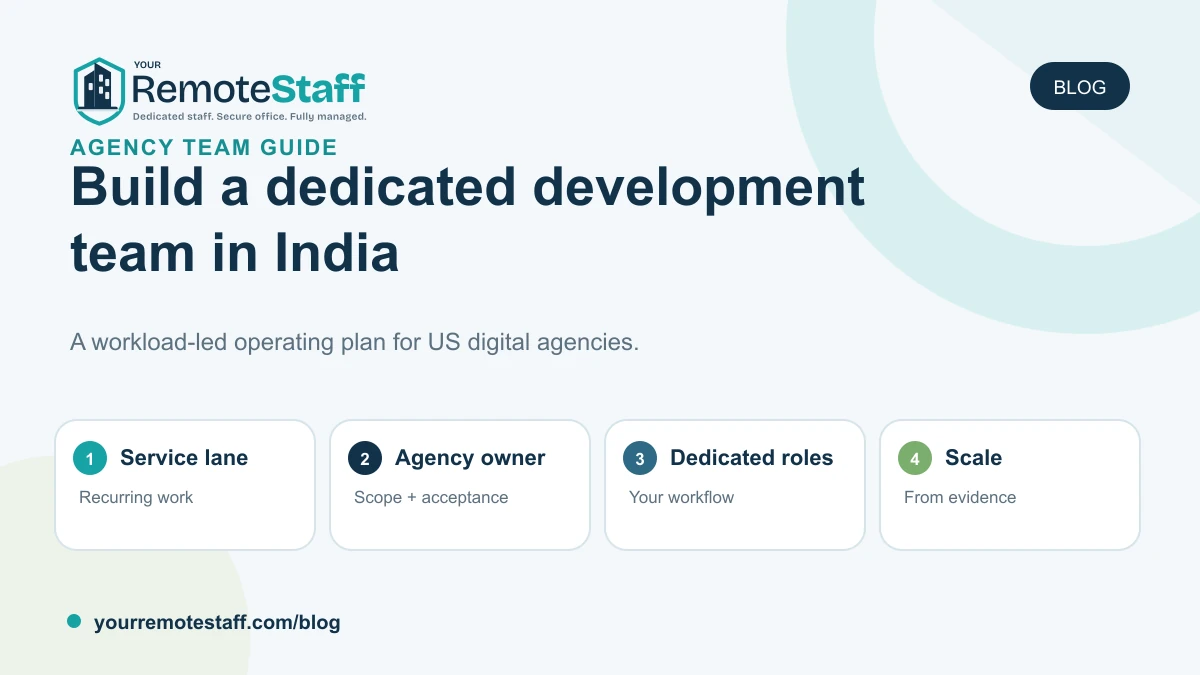
- Dedicated staffing adds named capacity to the agency’s workflow; it does not transfer project ownership by default.
- Choose the first seat from recurring backlog evidence, then name an internal owner for priority, review, and acceptance.
- Client agreements, access controls, and release responsibilities must be mapped before assigning client work.
- Scale the pod from measured queues, rework, review, and release evidence—not a preset offshore org chart.
In this guide 16 sections
A dedicated development team gives an agency stable capacity, not outsourced project ownership
A dedicated development team for a digital agency is a stable group of professionals who work exclusively within the agency’s delivery workflow across an ongoing client portfolio. The agency owns client relationships, scoping, priorities, technical decisions, review, acceptance, and releases. The staffing partner manages the agreed recruitment, employment, workspace, hardware, IT, HR, payroll, attendance, and local-support layer.
That is different from handing a fixed project to a white-label development company. A project vendor normally owns an agreed scope and deliverable. A dedicated team adds named people to the agency’s operating system, and the agency directs their work.
For a US digital agency, the model is most useful when one service lane has repeatable demand: WordPress builds, website maintenance, Webflow delivery, Shopify development, front-end implementation, custom applications, integrations, or QA. Build the first seat around that recurring queue, then add roles only when live work reveals the next constraint.
White-label describes presentation, not the operating model
Work may be delivered behind an agency’s brand only when the agency’s client commitments permit it. White-label project outsourcing, freelancers, and dedicated staffing can all sit behind an agency brand, but they allocate scope, management, access, and delivery responsibility differently.
What “dedicated development team for agencies” should mean
The word “dedicated” is used loosely. Before comparing providers, define it operationally.
A genuinely dedicated agency team should have:
- Named professionals assigned to the agency rather than a rotating delivery pool
- Clear working hours and an agreed collaboration window
- Direct participation in the agency’s task, communication, documentation, and review systems
- Stable role boundaries and named reviewers
- Access limited to the client accounts and systems required for assigned work
- A consistent feedback and performance process
- A continuity plan when someone takes leave, resigns, or needs replacement
The agency should be able to answer who is doing the work, who reviews it, which client environment they may access, and what happens before anything reaches production.
Dedicated staffing versus adjacent agency delivery models
| Model | Who directs daily work? | Who owns the client deliverable? | Strong fit |
|---|---|---|---|
| Dedicated staffing | The agency | The agency | Recurring capacity inside an established agency workflow |
| White-label project outsourcing | The project vendor under the agreement | Usually the vendor for the contracted scope, with the agency accountable to its client | Defined projects or outcomes the agency wants another delivery organization to run |
| Freelancers | The agency, within the independent engagement boundary | Usually the agency | Variable specialist work without a permanent seat |
| Internal US hire | The agency | The agency | A role requiring direct local employment or physical presence |
Contracts can allocate responsibilities differently, so verify the actual statement of work rather than relying on the category label. This article focuses on dedicated staffing; the future permanent comparison page will address the broader staffing-versus-outsourcing decision.
Is your agency ready for a dedicated India team?
Do not start with “How many offshore developers should we hire?” Start with the work system that those developers would enter.
Signal 1: one service lane has recurring demand
A dedicated seat needs a durable queue. Useful evidence includes:
- Similar website builds arriving repeatedly
- A maintenance backlog across multiple client sites
- Design handoffs waiting for implementation
- Custom integration work recurring across accounts
- Release testing consuming developer or account-manager time
- A sustained application backlog that exceeds current delivery capacity
One unusually large project is not the same as a repeatable service lane. If demand disappears when that project ends, a fixed-scope partner or specialist contractor may be more appropriate.
Signal 2: someone inside the agency can own delivery
Name the person who will:
- Translate client commitments into prioritized work
- Resolve requirement ambiguity
- Make or escalate technical decisions
- Review work and provide timely feedback
- Approve releases
- Communicate with the client
This owner may be a technical director, delivery lead, senior developer, product-minded account lead, or agency principal. The title matters less than the authority and available review time.
A dedicated developer cannot simultaneously become the client strategist, estimator, project manager, architect, reviewer, and implementer by default. If no internal owner exists, solve that management gap before adding execution capacity.
Signal 3: the agency has a visible workflow
The team needs one reliable place to find:
- Priorities
- Requirements and acceptance criteria
- Designs and content
- Technical context
- Access requests
- Review status
- Release decisions
- Client feedback
If work arrives through scattered direct messages and urgent calls, adding a remote seat will increase coordination noise. Standardize intake and prioritization first.
Signal 4: client commitments permit the delivery setup
Review the agreements and representations made to each client. Depending on the relationship and jurisdiction, relevant terms may cover confidentiality, intellectual property, privacy, data processing, subcontractors, personnel locations, background checks, systems access, security controls, or notice and approval.
There is no universal rule that applies to every agency-client contract. Have qualified counsel interpret the agreements and required disclosures. Commercially, the important point is simple: do not design an offshore delivery workflow that conflicts with what the agency promised its clients.
Signal 5: the agency can keep a seat productively assigned
Dedicated capacity works best when the agency can maintain a prioritized queue without filling gaps with random low-value tasks. Review several months of actual demand by service lane, not just the current week.
The goal is not maximum busyness. The goal is a durable flow of useful work with enough room for review, documentation, testing, and improvement.
Choose the first delivery pod from repeatable work
Do not copy another agency’s org chart. Choose the pod whose first seat removes your most persistent constraint.
Pod 1: website production and maintenance
This pod fits an agency with recurring marketing-site builds, landing pages, site changes, maintenance, and integrations.
Typical first seat
- WordPress developer when most demand is WordPress, WooCommerce, themes, plugins, and builders
- Webflow developer when the queue centers on Webflow implementation, CMS, interactions, and updates
- Cross-platform web developer when normal work spans several established platforms
Possible second seat
- Web designer for page layouts and implementation-ready design
- Front-end developer for custom interfaces beyond the core platform
- A second platform developer when the same queue remains the bottleneck
Possible third seat
- QA professional when regression checks across many sites consume delivery time
- Another specialist for a second platform with predictable demand
This is often the most practical agency pod because the service lane can be defined concretely: build, maintain, and improve a known portfolio of sites. Compare the available web development roles before turning “web developer” into a job brief.
Pod 2: custom web application delivery
This pod fits an agency building software products, portals, dashboards, internal tools, or integration-heavy applications for clients.
Typical first seat
- Senior full-stack developer when features cross the interface, API, and data layer and one person can own connected work
- Front-end or back-end specialist when one layer already has a sustained queue and the agency has architecture and review ownership
Possible second seat
- The complementary front-end or back-end role when both lanes can progress independently
- Another full-stack developer when connected feature work remains the dominant queue
Possible third seat
- QA automation engineer once repeatable release verification becomes a material workload
- Platform or DevOps capacity when deployment and environment work becomes a sustained constraint
Use the guide on one full-stack developer versus separate specialists and the developer seniority framework to define the first role from the work—not from a preferred title.
Pod 3: e-commerce and growth-site delivery
This pod fits agencies with repeatable Shopify, WooCommerce, campaign-site, conversion, and marketing-technology work.
Typical first seat
- Shopify developer for Liquid, Online Store 2.0, app integrations, checkout extensions, and storefront work
- WooCommerce developer for WordPress commerce, payment, catalog, shipping, and integration work
- Web developer for campaign pages and mixed marketing-site execution
Possible second seat
- Web or UI designer for campaign and storefront design
- Front-end specialist for custom customer experiences
- SEO or analytics specialist when the agency has a separate, sustained optimization lane
Possible third seat
- QA for checkout, payment, catalog, and cross-device regression
- A second platform specialist when the portfolio supports parallel queues
For live commerce environments, the agency must define staging, approval, release, rollback, and access procedures before assigning production work.
Quick pod-selection table
| Recurring agency demand | Practical first seat | Add next when | Internal owner required |
|---|---|---|---|
| WordPress builds and maintenance | WordPress developer | Design handoff or regression becomes the next queue | Website delivery lead |
| Mixed marketing sites | Web developer | One platform or design lane becomes consistently constrained | Web delivery lead |
| Connected application features | Senior full-stack developer | Front-end and back-end work can move in parallel | Technical lead |
| Established application with a UI queue | Front-end developer | API availability or regression becomes the constraint | Engineering lead |
| Shopify or WooCommerce portfolio | Platform specialist | Design, custom front-end, or checkout QA becomes sustained | E-commerce delivery lead |
| Repeated manual release verification | QA or QA automation engineer | Test execution or framework maintenance exceeds one role | Engineering or QA owner |
These are starting hypotheses. Validate them against the backlog and review capacity.
Complete the Agency Delivery Pod Canvas
Write one page before recruiting. If the agency cannot complete these eight fields, the role is not ready.
1. Service lane
Name the recurring work the pod will support:
WordPress builds and maintenance for retained agency clients.
Avoid “help with development.” It is too broad to recruit, onboard, or measure.
2. Demand evidence
List the evidence that the lane is durable:
- Open backlog by work type
- Recent completed work
- Work declined or delayed due to capacity
- Forecasted retained-client demand
- Repeated contractor usage
- Internal people currently pulled away from higher-value work
3. Internal owner
Name one accountable agency person for priority, clarification, review, acceptance, and client communication.
4. First-seat ownership
Describe what the person will own:
Implement approved designs, maintain the assigned WordPress portfolio, document material changes, and prepare releases for agency review.
This is more useful than a technology list alone.
5. Definition of ready
Specify what must exist before work starts:
- Client and site identified
- Requirement and business purpose
- Designs or content where required
- Acceptance criteria
- Environment and access approved
- Reviewer named
- Release constraints recorded
6. Definition of done
Specify completion:
- Implementation matches accepted requirements
- Code or configuration reviewed
- Tests and checks completed
- Responsive and browser requirements checked
- Documentation updated
- Agency reviewer accepts the work
- Release or handoff status recorded
7. Access boundary
List the systems, environments, client accounts, data, and production permissions the role may use. Define who approves and removes each access level.
8. Next-seat trigger
Choose an observable signal:
- Design-ready work repeatedly waits for implementation
- Developers repeatedly wait for design
- Back-end and front-end queues can run in parallel
- Manual regression delays releases
- One platform’s backlog remains sustained after the first seat is productive
- Review capacity, rather than implementation, becomes the bottleneck
Practical next step
Turn the decision framework into a role requirement your team can use.
Design your agency delivery team→Build an agency-owned delivery workflow
A dedicated India team succeeds when it enters a clear workflow. The following model keeps client accountability with the agency.
1. Client intake
The agency gathers the business requirement, desired outcome, constraints, deadline, budget or retainer boundary, and required approvals. The dedicated team should not have to reconstruct the client promise from a forwarded email.
2. Scope and priority
The agency converts the request into an approved project, epic, ticket, or maintenance item. It decides whether the work belongs in the dedicated team’s lane and where it ranks against other client commitments.
3. Definition of ready
The delivery owner verifies designs, content, acceptance criteria, dependencies, access, and reviewer availability. Work that is not ready remains visible but does not enter active development.
4. Implementation
The dedicated professional works in the agency’s repository, task system, documentation, and communication rhythm. Questions and decisions remain attached to the work so future team members can recover context.
5. Technical and agency review
The named reviewer checks architecture, code, configuration, design fidelity, security expectations, and maintainability at the level appropriate for the task. The agency—not the staffing provider—accepts the client-facing output.
6. QA and acceptance
The team runs the agreed automated and manual checks. The agency verifies the result against client acceptance criteria and routes material questions to the client.
7. Release
The agency controls release approval. Production access should follow the client-approved access model, with an identified rollback and escalation path.
8. Feedback and improvement
Capture defects, rework, delayed decisions, review queues, and release issues. Use the evidence to improve the workflow and decide whether the next constraint requires another role.
Measure delivery without turning metrics into quotas
Agency owners need evidence that the pod is improving delivery. Start with a small set of operational questions:
- How long does ready work wait before implementation starts?
- How long does work take from start to agency acceptance?
- How much work returns because requirements were incomplete?
- How much returns because implementation missed accepted criteria?
- How long do reviews and client decisions wait?
- How often do releases require urgent correction?
- Which queue is growing despite the new capacity?
For application delivery, DORA separates throughput and instability using change lead time, deployment frequency, failed deployment recovery time, change fail rate, and deployment rework rate. Its guidance also warns against using one metric as a target or comparing unlike applications. See DORA’s software delivery performance metrics↗.
An agency serving many clients should preserve that context. A brochure website, e-commerce store, and custom SaaS application do not share the same release profile. Use metrics to improve a service lane or application over time—not to rank developers working on unrelated client systems.
Measure the system before blaming the seat
Slow delivery may come from unclear requirements, missing content, delayed access, review queues, or client approval—not implementation speed. Measure wait states as well as active work.
Protect client access, confidentiality, and intellectual property
An office-backed team does not replace the agency’s security governance. Before granting access, map the contractual and operational boundary for each client.
Review client obligations
Ask the appropriate legal, privacy, and security owners to review:
- Confidentiality and intellectual-property terms
- Personnel, subcontractor, and work-location provisions
- Data-processing and privacy obligations
- Client security requirements
- Background-check requirements
- Incident-notification and cooperation duties
- Restrictions on production, financial, healthcare, or other sensitive systems
The answer can differ by client. A delivery setup acceptable for a public marketing site may not be acceptable for a regulated application or production database.
Create an access matrix
For each role and client, record:
| Access item | Business need | Environment | Approver | Authentication | Review and removal |
|---|---|---|---|---|---|
| Source repository | Implement assigned work | Client-specific repository | Technical owner | Named account and MFA where supported | Review periodically and remove at exit |
| CMS or commerce admin | Configure and validate approved changes | Staging by default; production only when approved | Client or agency owner | Named account or approved vault process | Review after project or role change |
| Hosting and deployment | Release approved work | Defined environment | Release owner | Least access needed for the release model | Remove when no longer required |
| Analytics or customer data | Only when required for assigned work | Minimum necessary dataset | Data owner | Client-approved controls | Review against current role |
Do not copy this example mechanically. Select controls according to the client system, data, contract, and risk.
Apply practical access discipline
- Use named accounts instead of shared credentials where systems support them
- Require multifactor authentication where available and approved
- Grant the minimum access needed for current work
- Separate staging and production permissions
- Use an approved password or secrets-management process
- Keep client work in the correct repositories and communication spaces
- Record material release and access decisions
- Remove access promptly when roles or assignments change
- Test the incident and escalation contact path before it is needed
NIST SP 800-53 organizes security and privacy controls across access control, identification and authentication, audit and accountability, incident response, personnel security, system integrity, and other families. NIST emphasizes selecting and tailoring controls to organizational and risk needs; it is not a one-size-fits-all checklist for an agency pod. See NIST SP 800-53 Rev. 5↗.
Use the India remote staffing security guide to turn workplace, device, network, access, and incident expectations into provider questions.
Design US–India collaboration around decisions
The goal is not to keep everyone in meetings for the entire US day. Define the overlap needed for decisions, reviews, and releases, then let documented work continue asynchronously.
Agree on:
- Core collaboration window
- Standup or written-status format
- Expected response time for blockers
- Review turnaround
- Client-meeting participation, if any
- Planned release windows
- Urgent escalation path
- Holiday and leave visibility
Use live overlap for requirement clarification, architecture decisions, pairing, review, and time-sensitive releases. Use written systems for backlog status, decisions, acceptance criteria, documentation, and normal progress.
The US–India time-zone guide explains how to choose overlap intentionally rather than defaulting to a full night shift.
Hire for the agency’s actual work
A generic “full-stack developer with every framework” description produces a generic search. Build the role brief from the delivery lane.
Include:
- Platforms and versions in the active portfolio
- Representative ticket types
- Build versus maintenance mix
- Expected code-review and documentation practices
- Design-handoff process
- Testing and release responsibilities
- Client communication expectations, if any
- Working-hour overlap
- Access and confidentiality requirements
- Named internal reviewer
Use non-confidential examples during evaluation. A structured interview can test technical judgment, communication, estimation assumptions, debugging approach, review habits, and willingness to surface ambiguity.
The agency makes the final candidate choice. Use the remote staff interview guide to build an evidence-based scorecard and the onboarding guide to prepare access, workflow, and first-month expectations.
An illustrative first-30-days launch plan
The exact plan should fit the role and client constraints. This sequence is a starting template after the person begins.
Before day one
- Confirm the internal owner and reviewer
- Prepare the role charter and first prioritized backlog
- Collect approved, non-confidential onboarding material
- Establish accounts through the access-approval process
- Document coding, design, QA, communication, and release standards
- Select a bounded first task
Days 1–5: learn the lane
- Introduce the agency, services, and team
- Walk through the delivery workflow
- Review representative completed work
- Set up local development and approved systems
- Confirm client and environment boundaries
- Complete a bounded, reviewable task
The first task should reveal how the person reads requirements, asks questions, follows standards, and responds to review. It should not require unrestricted production access.
Days 6–10: complete a normal work item
- Assign work representative of the recurring queue
- Observe clarification and estimation behavior
- Review implementation and documentation
- Test the acceptance and release process
- Give specific feedback quickly
Days 11–20: enter the normal backlog
- Increase task breadth within the role boundary
- Track wait time for requirements, access, and review
- Pair on unfamiliar client or platform context
- Confirm communication and overlap rhythm
- Document recurring questions
Days 21–30: review the system
Assess:
- Is the service lane still the right ownership boundary?
- Is the backlog ready enough?
- Is review timely?
- Are access controls practical?
- Where does work wait?
- What requires more documentation or training?
- Is the next constraint design, development, QA, review, or client approval?
Do not decide on the second seat only because the first month ended. Add the next role when the workload and operating evidence support it.
Compare complete agency capacity, not hourly rates alone
The financial question is not only whether one developer costs less in one location. Compare the complete system required to deliver accepted client work.
Include:
- Recruiting and screening
- Compensation and employment costs
- Provider fee
- Workspace, hardware, internet, and IT support
- Agency management and review time
- Design, QA, platform, and release dependencies
- Idle time caused by incomplete requirements or delayed approvals
- Rework and production issues
- Replacement and knowledge-transfer impact
- Tools, licenses, and client-required controls
A low rate does not create capacity if the agency lacks a prepared backlog and review owner. A higher-seniority seat does not create leverage if all work consists of routine platform tickets. Match the role and operating model to the actual queue.
Review current dedicated-seat pricing only after defining the first role and the local support the agency needs.
When a dedicated India team is not the right answer
Choose another model when:
- Demand is a single fixed project with no recurring service lane
- The agency wants a vendor to own scope, project management, and the final deliverable
- Client agreements or required controls do not permit the proposed setup
- No internal person can own priorities, technical decisions, review, and acceptance
- The workload is too intermittent to sustain a dedicated seat
- The role requires physical presence near the client
- The agency needs a rare specialist for only a short intervention
- Requirements and access are too disorganized for a remote professional to work safely
The right response may be a fixed-scope partner, a qualified independent specialist, a direct US hire, an internal process improvement, or simply delaying the hire until the lane is ready.
Where YourRemoteStaff fits
YourRemoteStaff is an office-backed dedicated staffing model operated by Salt Technologies. It is built for agencies that want named professionals working exclusively within their team but do not want to establish India recruitment, employment, office, hardware, IT, HR, payroll, attendance, and replacement operations.
The operating boundary is explicit:
| Your agency directs | YourRemoteStaff manages |
|---|---|
| Client relationship and commitments | Recruitment and candidate coordination |
| Scope, priorities, and task assignment | Secure managed office workspace |
| Architecture, technical standards, and tools | Standard hardware and local IT support |
| Access approval and client-specific controls | HR, payroll, attendance, and leave administration |
| Review, acceptance, and release decisions | Employment operations and local escalation |
| Feedback on work and role expectations | Retention and replacement support around the seat |
You interview and choose each candidate. The selected person is a dedicated professional working exclusively for your team, employed and managed by us in India. The person follows your tools, standards, priorities, and review process.
YourRemoteStaff does not become the agency’s account manager, project owner, architect, or client-delivery manager by default. If the requirement is to hand off a fixed scope and hold a vendor accountable for the finished project, evaluate a project-delivery partner instead.
See how office-backed remote staffing works and the available web development roles when you are ready to turn the delivery lane into a first-seat requirement.
Build the smallest complete pod
A strong agency delivery pod starts with one recurring lane, one accountable internal owner, one clearly bounded first role, and one visible workflow. It does not start with a large offshore org chart.
Use actual backlog evidence to choose the first seat. Protect client commitments with approved access and delivery controls. Measure wait states, review, rework, throughput, and release stability. Add the next role only when the live system identifies the next sustained constraint.
If you want to map a WordPress, web, application, e-commerce, design, or QA lane into dedicated roles, share your agency’s recurring workload. We will explain which staffing seats fit, what your agency will need to own, and when another model may be more appropriate.
Source notes and disclaimer
- DORA’s software delivery performance metrics, last updated 2026-01-05 and accessed 2026-07-14, support the distinction between throughput and instability and the cautions against metric gaming and comparing unlike applications. They are not used as staffing targets.
- NIST SP 800-53 Rev. 5 and its current release information, accessed 2026-07-14, support the general security-control families referenced here. The article does not claim that adopting the listed operational practices creates NIST compliance.
- The Agency Delivery Pod Canvas and launch plan are editorial operating frameworks. They are not guarantees of delivery performance or client acceptance.
- Contract, confidentiality, intellectual-property, privacy, security, subcontractor, work-location, and disclosure requirements vary. This article is general commercial information, not legal, tax, privacy, employment, or security advice.
Common questions