AT A GLANCE
What you’ll learn
- Confirm the same role, seniority, schedule, and operating requirement before comparing price.
- Normalize every quote using included, pass-through, add-on, buyer-owned, and unclear labels.
- Keep monthly operating cost, first-year cost, and refundable pre-start cash separate.
- Compare retained buyer work, replacement, foreign exchange, notice, and offboarding—not only the invoice.
- Treat a lower-scope quote as a valid option when your company can reliably own the excluded functions.
In this guide 23 sections
The short answer
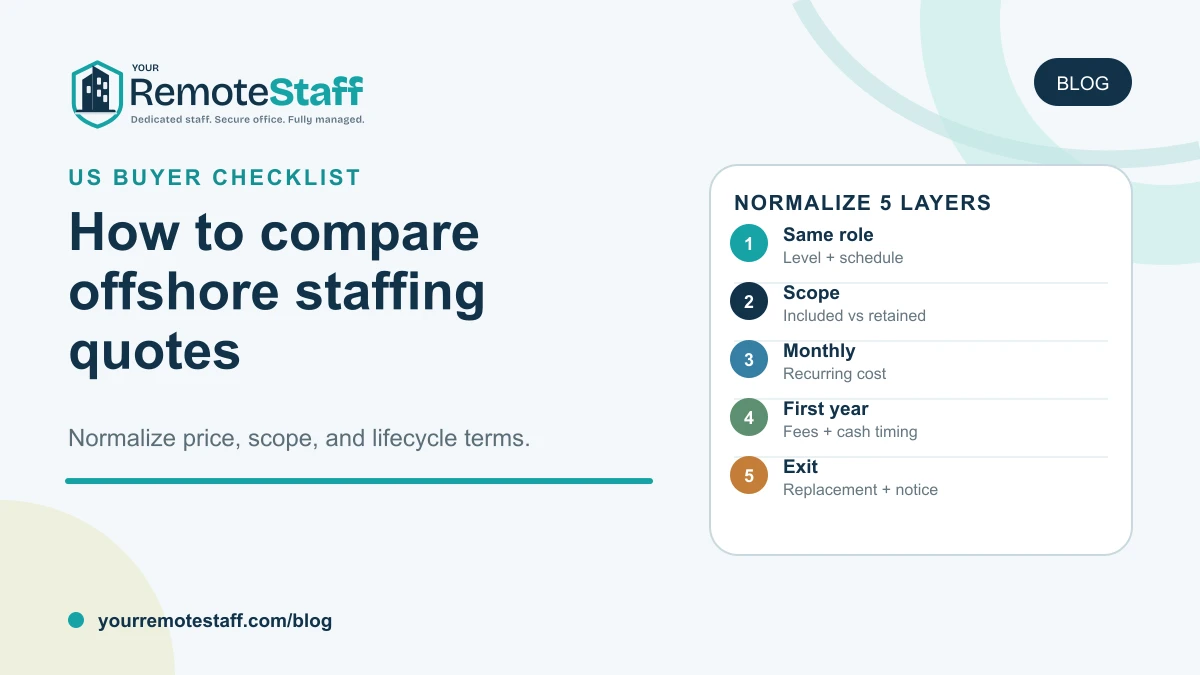
To compare offshore staffing quotes, first confirm that every provider is pricing the same role, seniority, working hours, and operating requirement. Then move each proposal into one worksheet and classify every cost or responsibility as included, pass-through, add-on, or buyer-owned.
Compare three different numbers:
- Normalized monthly operating cost
- First-year cost
- Cash required before the person starts
Finally, compare the work your company still needs to perform: recruitment, screening, office, hardware, IT, payroll coordination, access, attendance, replacement, and offboarding. A lower quote may be genuinely lower because it includes less. That is not automatically a problem—as long as your company can supply the missing functions and the proposal makes them clear.
Do not compare headline numbers yet
A $1,700 salary-plus-fee quote and a $2,200 managed-seat quote may describe different roles, services, and risk allocation. Normalize the scope before deciding which price is lower.
This guide is written for US small and midsize companies, agencies, finance leaders, operations teams, and functional managers evaluating dedicated offshore staffing proposals. It is not a market-rate report or a substitute for legal, tax, employment, security, or accounting review.
Why offshore staffing quotes are difficult to compare
Two proposals can use the same phrase—“dedicated offshore staff”—while pricing different things.
One provider may quote:
- The professional’s compensation
- A service fee
- Payroll administration
Another may quote one monthly seat that also includes:
- Recruitment and screening
- Managed office workspace
- Standard hardware
- Internet and local IT
- HR and payroll
- Attendance and leave support
- Local escalation
- Replacement support
A third proposal may be for project delivery rather than a client-directed staffing seat. It may include a project manager and acceptance obligations instead of a named professional working inside your workflow.
The quote format is not evidence that one model is better. It tells you what still needs to be mapped.
Price and scope are separate questions
Ask:
- What does this price include?
- What required work remains with us?
- What could change the price?
- What cash is required upfront?
- What happens when the person, role, or engagement changes?
Only then ask which proposal provides the better commercial fit.
Step 1: Confirm every quote describes the same role
Price normalization fails if the underlying talent requirement differs.
Create one role baseline:
| Role assumption | Baseline to send every provider |
|---|---|
| Role title | One functional title |
| Core outcome | What the person will own |
| Must-have skills | Small, ranked list |
| Seniority | Defined by ownership and judgment |
| Experience evidence | Relevant work, not years alone |
| Working hours | Exact time zone and overlap |
| Employment/start location | Country and city constraints, if any |
| Workplace | Managed office, home-based, or buyer-defined |
| Hardware | Standard and specialized requirements |
| Software | Required paid licenses |
| Data/access | Systems and sensitivity |
| Team structure | Manager, reviewers, and collaborators |
| Start timing | Realistic target and dependencies |
Check candidate assumptions
One proposal may assume:
- A junior professional following documented tasks
Another may assume:
- A senior professional independently owning an ambiguous function
The higher quote may reflect different capability rather than a higher markup.
Ask each provider to state:
- Candidate level
- Relevant experience
- Scope of independent ownership
- Communication expectations
- Screening completed before your interview
- Whether the final price changes with the selected candidate
If the providers are not quoting the same role, separate talent evaluation from provider-cost evaluation.
Keep must-haves consistent
Do not send one provider a broad requirement and another a narrower one.
For example:
- “Full-stack developer” can describe bounded feature work under technical review.
- It can also describe architecture, front-end, backend, cloud, DevOps, security, mentoring, and customer communication.
Those are not the same seat.
Use the remote staff interview guide to create one evidence-based role scorecard before comparing final candidate prices.
Step 2: Identify the commercial structure behind each quote
Do not force unlike structures into the same label. Record what the provider is actually quoting.
One monthly managed-seat price
The provider quotes one recurring amount covering the professional plus a defined operating bundle.
Verify:
- Included functions
- Add-ons
- Candidate-specific price changes
- Compensation-review treatment
- Deposits
- Notice and exit terms
Compensation plus provider fee
The proposal separates the person’s compensation from the provider’s recurring fee.
Verify:
- Benefits and statutory costs
- Payroll funding
- Foreign-exchange treatment
- Workspace, hardware, and IT
- Recruiting or placement fees
- Fee changes when compensation changes
Service fee plus pass-through expenses
The provider charges a recurring administration fee and invoices other items at cost or through partners.
Verify:
- Which expenses are pass-through
- Supporting documentation
- Currency conversion
- Taxes or markups
- Approval thresholds
- Timing and variability
One-time placement fee
The provider may source or place a candidate, while employment and operations remain with the buyer or another party.
Verify who owns:
- Employment
- Payroll
- Workplace
- Equipment
- IT support
- Attendance
- Retention
- Replacement
Project or managed-delivery quote
The vendor prices a defined deliverable, team, or capacity block and may own project management.
That proposal may be commercially valid, but it should not be compared directly with one dedicated person until the company decides whether it wants project delivery or client-directed staff. The first India team model guide helps define that operating requirement.
Step 3: Use the Offshore Staffing Quote Normalization Worksheet
Create one column per provider. Do not leave a required cell blank.
Use these statuses:
- Included: Covered by the quoted recurring price
- Pass-through: Invoiced separately based on actual or stated cost
- Add-on: Optional or separately priced service
- Buyer-owned: Your company supplies and manages it
- Not required: Your role does not need it
- Unclear: Written clarification required
| Workstream or cost | Quote A treatment and amount | Quote B treatment and amount | Buyer question |
|---|---|---|---|
| Professional compensation | Included in seat or funded separately? | ||
| Mandatory/standard benefits | Which benefits and assumptions apply? | ||
| Statutory administration | Which obligations are administered and on what basis? | ||
| Provider/service fee | Fixed, percentage, tiered, or candidate-dependent? | ||
| Recruitment/sourcing | Included, placement fee, or buyer-owned? | ||
| Skills/communication screening | What occurs before the client interview? | ||
| Background/reference checks | Which checks, who performs them, and what is optional? | ||
| Office/workspace | Where does the person work and what is included? | ||
| Standard hardware | Device specification, ownership, replacement, and return? | ||
| Specialized devices | Quoted upfront or purchased later? | ||
| Internet/network | Included and locally supported? | ||
| IT setup/help desk | Who configures, repairs, replaces, and removes access? | ||
| Paid software/licenses | Provider, buyer, or pass-through? | ||
| Security requirements | Standard controls versus client-specific setup? | ||
| HR/payroll support | Which routine and exception processes are included? | ||
| Attendance/leave support | Records only or active local coordination? | ||
| US-hours premium | Exact schedule, premium, and holiday assumptions? | ||
| Account/local escalation | Named support owner and service expectations? | ||
| Replacement sourcing | Included, limited, or separately charged? | ||
| Vacancy/handover support | What happens between resignation and replacement? | ||
| Setup/onboarding fee | Nonrefundable, credited, or conditional? | ||
| Deposit/reserve | Refundable, applied to invoices, or held through exit? | ||
| Foreign-exchange treatment | Currency, rate source, markup, and reset timing? | ||
| Compensation adjustments | Review schedule, approval, and fee impact? | ||
| Invoice taxes/charges | Included, pass-through, or added? | ||
| Notice/early exit | Notice period and remaining payment obligations? | ||
| Offboarding/final payroll | Included or separately charged? | ||
| Equipment return/disposal | Process, owner, and cost? |
The worksheet is intentionally longer than a pricing table. A staff seat is an ongoing operating arrangement, so the lifecycle matters.
Practical next step
Turn the decision framework into a role requirement your team can use.
Review the staffing partner checklist→Step 4: Separate recurring cost, one-time cost, and cash timing
These numbers answer different questions.
Normalized monthly operating cost
Use:
Normalized monthly operating cost = recurring provider charges + recurring pass-through costs + recurring add-ons + recurring buyer-owned costs required for the seat
Examples of recurring buyer-owned cost:
- Paid software licenses
- Security tools
- Specialized support
- Internal manager capacity
- Coworking or device support if excluded
Do not invent a dollar value for internal work solely to make a preferred quote look better. Record the retained work even when finance does not assign it a cost.
First-year cost
Use:
First-year cost = 12 × normalized monthly operating cost + nonrefundable setup/placement fees + annual or periodic required charges
If the role is expected to start partway through a month, use the contract’s proration rules.
Cash required before start
Track separately:
Pre-start cash = first invoice + refundable deposit/reserve + nonrefundable setup/placement fees + prepaid equipment/software
A refundable deposit affects cash flow but is not automatically an expense. Record:
- Refund conditions
- Application to final invoices
- Return timing
- Deductions
- Currency
Planned-term cost
If the business is evaluating a specific period:
Planned-term cost = normalized recurring cost over the term + required one-time charges + known renewal/exit charges
Do not assume an initial promotional rate continues unless the agreement says so.
Step 5: Compare compensation and employment assumptions
A staffing quote may bundle compensation. Another may show it separately. Ask both providers to explain the assumptions without requesting private employee payroll data that the buyer is not entitled to receive.
Clarify:
- Role and seniority basis
- Compensation currency
- Benefits included
- Review frequency
- Market-adjustment process
- Performance-increase process
- Bonus or variable-pay treatment
- Overtime or schedule treatment, where relevant
- Provider-fee impact when compensation changes
Verify India-specific administration without applying one global percentage
India employment-cost assumptions can depend on the employing establishment, location, wage conditions, benefit design, and individual facts.
For example:
- The Employees’ Provident Fund Organisation publishes information for employers↗ covering establishment registration, returns, and contributions.
- The Employees’ State Insurance Corporation publishes coverage information↗ showing that applicability depends on factors including establishment, location, and wage conditions.
These sources do not tell a US buyer which amount applies to one candidate. They show why the quote should state its assumptions and why qualified India advice may be required.
Ask:
- Which India entity employs the person?
- Which statutory and benefit assumptions are included?
- What changes if compensation or location changes?
- Who monitors and implements applicable changes?
- Which items are provider-funded, employee-funded, or buyer-funded?
Do not treat a vague “all compliance included” line as a complete cost schedule.
Step 6: Compare recruitment and screening scope
“Candidate included” can describe several different processes.
Ask who will:
- Turn the workload into a role brief
- Source candidates
- Review resumes
- Assess role-specific skills
- Assess business communication
- Validate remote-work readiness
- Conduct references
- Coordinate appropriate background checks
- Schedule interviews
- Revise the search after rejected candidates
- Coordinate the offer
Define “screened”
Request the screening stages in writing.
For a developer, screening may include:
- Stack-relevant experience
- Code or architecture discussion
- Practical exercise
- Communication
For an assistant, it may include:
- Prioritization
- Written communication
- Accuracy
- Escalation judgment
A resume forwarded by a recruiter and a candidate evaluated through a structured process do not represent the same service.
Clarify recruitment fee treatment
Record whether recruitment is:
- Included in the monthly seat
- Charged once
- Charged after successful placement
- Credited after a trial
- Recharged on replacement
- Limited to a stated number of searches
Do not label a separately disclosed recruitment fee a hidden cost. Normalize it as a one-time cost and decide whether the service is useful.
Step 7: Compare office, hardware, IT, and software
The role needs a real working environment.
Workplace
Ask:
- Where will the person work?
- Is the workspace dedicated, shared, home-based, or optional?
- Is power and internet resilience part of the service?
- Are working hours permitted at the location?
- Who handles workplace issues?
- Can the buyer review evidence appropriate to the engagement?
If your company does not require a managed office, do not pay for one merely to make the quote look more complete. If the role handles sensitive systems, requires local IT, or needs stable attendance and infrastructure, define those requirements before removing the line.
Hardware
Record:
- Device specification
- Ownership
- Purchase or lease
- Setup
- Repair
- Replacement
- Warranty
- Return
- Secure wipe or disposal
- Specialized device requirements
“Laptop included” is not enough if the role needs high-memory development hardware, Apple devices, test phones, multiple monitors, a headset, or other equipment.
IT support
Ask who owns:
- Device configuration
- Approved software installation
- Patch support
- Endpoint controls
- Help-desk response
- Hardware replacement
- Account setup coordination
- Offboarding
Paid software
List every license required for the role.
Common treatments:
- Buyer provides an existing company license
- Provider purchases and passes through the cost
- Provider includes a standard toolset
- License is a quoted add-on
Keep the treatment consistent across quotes.
Step 8: Compare security scope without accepting vague labels
Security is a shared operating responsibility.
NIST’s Guide to Enterprise Telework, Remote Access, and Bring Your Own Device↗ treats remote access as a system involving policy, architecture, implementation, and lifecycle management. CISA’s small-business MFA guidance↗ recommends MFA for remote and privileged or administrative access.
Ask each provider to separate:
Standard included controls
Examples may include:
- Managed office access
- Provider-owned standard hardware
- Local IT support
- Device setup
- Network controls
- Employment confidentiality obligations
Client-owned controls
Examples:
- Identity provider
- Application permissions
- MFA policy
- Repository access
- CRM roles
- Data classification
- Logging
- Approval workflows
- Incident response
Client-specific add-ons
Examples:
- Specialized endpoint tooling
- Dedicated devices
- Restricted network design
- Additional monitoring
- Customer-required evidence
- Role-specific background checks
Do not accept “secure” as a substitute for a control, owner, evidence, response expectation, and price.
Use the India remote staffing security guide to build the requirement before asking providers to price it.
Step 9: Compare working hours and US overlap
“US hours available” is not specific enough.
Define:
- Time zone: Eastern, Central, Mountain, or Pacific
- Seasonal daylight-saving change
- Required daily overlap
- Meetings
- Shift start and end
- Breaks
- Weekends
- US and India holidays
- Emergency/on-call expectations
- Schedule-change notice
Ask:
- Is the schedule included?
- Does it change the candidate pool?
- Is there a monthly shift premium?
- Does the premium change with daylight saving time?
- Are transport or workplace arrangements needed for late hours?
- What happens if the selected candidate declines the schedule later?
The US–India time-zone guide can help define the actual collaboration window before providers quote it.
Step 10: Compare HR, payroll, attendance, and local support
Record whether the provider handles:
- Employment documentation
- Payroll
- Payslips
- Benefits administration
- Leave records
- Attendance records
- Routine HR questions
- Local workplace concerns
- Compensation changes
- Performance-process coordination
- Resignation
- Final payroll
Then record what your company retains:
- Daily work direction
- Priorities
- Tools
- Functional standards
- Output review
- Performance feedback on the work
- Access decisions
Do not assume “managed staffing” means the provider runs the client’s function. Your company usually remains the functional manager unless a separate service says otherwise.
Step 11: Compare replacement and continuity
Replacement support can affect both cost and operating risk.
Ask:
- Is a replacement search included?
- Which situations qualify?
- Is there another recruitment fee?
- Does the monthly charge continue during vacancy?
- Who owns knowledge transfer?
- How is access removed?
- Who retrieves and prepares equipment?
- Is interim capacity available?
- Does replacement reset the contract term?
- What happens if the replacement is also unsuitable?
Separate replacement from guaranteed continuity
Replacement sourcing does not mean:
- An identical candidate is immediately available
- No knowledge is lost
- Every vacancy is filled by a fixed date
- The client has no handover responsibilities
Score the actual process and commercial terms.
Step 12: Compare foreign-exchange treatment
Some quotes are fixed in USD. Others are tied to compensation in Indian rupees and converted for invoicing.
Ask:
- What is the invoice currency?
- Is compensation fixed in INR, USD, or another currency?
- Which exchange-rate source is used?
- Which date or averaging period applies?
- Is there a currency markup?
- How often is the rate reset?
- Is there a floor, ceiling, or adjustment threshold?
- Does the provider fee move with currency?
- How are refunds, deposits, and final invoices converted?
Do not forecast exchange rates inside the comparison unless finance has an approved scenario method. Instead, show:
- Current quoted treatment
- Adjustment rule
- Sensitivity scenario
- Buyer approval process
A fixed USD quote transfers some currency-management responsibility to the provider. A pass-through structure leaves more variability visible to the buyer. Neither is automatically better; the contract should make the allocation clear.
Step 13: Compare deposits, notice, and exit terms
A smaller first invoice may not produce the lowest lifecycle cost.
Deposits and reserves
Clarify:
- Amount
- Currency
- Refundability
- Permitted deductions
- Return timing
- Application to the final invoice
- What happens after a role or price change
Notice
Clarify:
- Notice period
- Payment during notice
- Immediate termination conditions
- Role-change process
- Candidate resignation treatment
- Provider breach process
Offboarding
Clarify ownership and cost for:
- Final payroll
- Leave settlement
- Benefits closure
- Device return
- Access removal
- Knowledge transfer
- File and data return
- Account closure
Ask qualified advisors to review the agreement for your circumstances. The worksheet is commercial planning, not a legal conclusion.
A fictional example: two quotes for the same role
The following numbers are fictional and illustrative only. They are not market averages, actual provider quotes, or YourRemoteStaff pricing.
Assume a US company is comparing the same mid-level role, schedule, office requirement, and standard equipment.
Quote A: bundled managed seat
- Monthly seat: $2,250
- Recruitment: included
- Managed office: included
- Standard hardware: included
- IT support: included
- HR and payroll: included
- Agreed US overlap: included
- Replacement sourcing: included
- Setup fee: $0
- Refundable deposit: $2,250
Normalized monthly operating cost:
$2,250
First-year cost:
12 × $2,250 = $27,000
Pre-start cash, assuming first invoice plus deposit:
$2,250 + $2,250 = $4,500
The refundable deposit is tracked as cash required, not automatically treated as cost.
Quote B: base price plus operating lines
- Base monthly price: $1,750
- Office: $150/month
- Hardware lease: $90/month
- IT support: $60/month
- HR/payroll administration: $125/month
- Agreed US-overlap premium: $100/month
- Recruitment fee: $900 once
- Deposit: $0
Normalized monthly operating cost:
$1,750 + $150 + $90 + $60 + $125 + $100 = $2,275
First-year cost:
12 × $2,275 + $900 = $28,200
Pre-start cash, assuming first invoice plus recruitment fee:
$2,275 + $900 = $3,175
What the example demonstrates
Quote B has a lower headline monthly number but a slightly higher normalized first-year cost in this fictional scenario. Quote A requires more pre-start cash because of the refundable deposit.
The decision is still incomplete.
The buyer must verify:
- Candidate quality and seniority
- Screening scope
- Benefits/statutory assumptions
- Hardware specifications
- Security responsibilities
- Replacement terms
- Notice and exit
- Foreign-exchange treatment
If the buyer already has an India workplace, hardware program, and local IT team, some Quote B add-ons could duplicate existing capabilities. In that case, the less bundled structure may be the better fit.
The worksheet exposes the trade-off without assuming the larger bundle always wins.
Count retained internal work
Some proposals shift required work to the buyer without showing a separate line item.
Record the internal owner and workload for:
| Retained function | Internal owner | Ready now? | Ongoing workload |
|---|---|---|---|
| Role definition | |||
| Candidate screening | |||
| Interview coordination | |||
| Local employment coordination | |||
| Workplace | |||
| Hardware procurement/support | |||
| IT help desk | |||
| Access/security governance | |||
| Attendance/leave coordination | |||
| Compensation review | |||
| Replacement search | |||
| Offboarding |
Do not automatically monetize every internal task. First establish whether the owner, process, and capacity exist.
A buyer with mature international operations may rationally retain more. A US SMB with no India infrastructure may prefer a wider provider scope even when the monthly invoice is higher.
Send one written clarification request
Use the same request for every provider:
Please return a complete responsibility and cost schedule for the quoted role. For each line, state whether it is included in the recurring price, passed through, available as an add-on, owned by our company, or not applicable. Include the amount or calculation method, currency, billing timing, adjustment rule, service owner, and contract reference. Please cover compensation, benefits/statutory administration, provider fees, recruitment and screening, background checks, workspace, hardware, internet, IT, software, security requirements, working hours, HR/payroll, attendance/leave, local escalation, replacement, setup, deposits, foreign exchange, compensation changes, taxes, notice, and offboarding.
Ask the provider to identify:
- Assumptions
- Exceptions
- Items still awaiting candidate selection
- Items still awaiting buyer requirements
- Partner-delivered services
- Any price that can change after signing
Specific written gaps are more useful than a long marketing feature list.
Score the normalized comparison
Use red, amber, and green.
Green
- Same role and seniority
- Required function has a named owner
- Price or calculation method is written
- Currency and timing are clear
- Service expectation is defined
- Contract reflects the answer
Amber
- Function is optional or partner-delivered
- Price depends on an unresolved requirement
- Service expectation is vague
- Buyer owner exists but process is immature
- Adjustment formula needs clarification
Red
- Required cost or owner is missing
- Employment or payroll responsibility is unclear
- Provider cannot explain where the person works
- Hardware, IT, or access ownership is unassigned
- A verbal assurance conflicts with the agreement
- Deposit, notice, or exit treatment is unknown
A red item does not automatically disqualify the provider. It stops the commercial decision until the gap is resolved.
Questions to ask before signing
Talent
- Is the final quote tied to a candidate or only a role range?
- What seniority and ownership does the quote assume?
- What screening occurs before our interview?
- What changes after a rejected shortlist?
Price
- What is the normalized recurring amount?
- Which costs are one-time, annual, pass-through, or refundable?
- Which charges can change after the candidate starts?
- How are compensation and currency adjustments handled?
Operations
- Where will the person work?
- Who owns hardware, internet, and IT support?
- Who manages HR, payroll, attendance, leave, and local escalation?
- Which software or client-specific requirements cost extra?
Continuity
- What happens if the person resigns?
- Is replacement sourcing included?
- What is charged during vacancy or notice?
- Who coordinates access removal and equipment return?
Contract
- Where is each material sales answer reflected?
- What notice and early-exit obligations apply?
- What deposit or reserve is held?
- Which services are delivered by another partner?
The broader guide to choosing an India remote staffing partner covers provider model, screening, workplace, evidence, and warning signs beyond the quote.
Where YourRemoteStaff fits
YourRemoteStaff quotes role-based monthly dedicated seats.
The standard seat includes:
- Recruitment and screening
- Managed office workspace
- Standard hardware
- IT support
- HR
- Payroll
- Attendance and leave support
- Replacement support
- Account support
Client-specific requirements such as specialized hardware, paid licenses, test devices, heavy US-hours coverage, security-specific setup, or a dedicated management layer are scoped and quoted upfront.
You interview and choose the professional. The person works exclusively with your team, and your company directs daily tasks, priorities, tools, feedback, and output review.
Review current monthly seat ranges and how the office-backed model works. If you already have another proposal, use the worksheet to compare both scopes rather than sending only the headline number.
Make the final recommendation decision-ready
Summarize each proposal in one paragraph:
Provider/Quote: [name or identifier]
Role baseline: [role, level, schedule]
Normalized monthly cost: [amount and currency]
First-year cost: [amount and assumptions]
Pre-start cash: [amount, including refundable items]
Included operating layer: [summary]
Buyer-retained work: [summary]
Material adjustment rules: [FX, compensation, add-ons]
Replacement/exit: [summary]
Open red/amber items: [list]
Recommendation: [proceed, clarify, or decline] because [reason].
The best quote is the one that:
- Fits the actual role
- Assigns every required responsibility
- Makes recurring and lifecycle costs understandable
- Matches the buyer’s internal capabilities
- Reflects the written agreement
It is not necessarily the quote with the lowest headline or the longest inclusion list.
If you want a scope-to-scope review of a proposal against the office-backed seat model, compare your staffing quote.
Source notes and disclaimer
- CISA and NIST guidance is used only to support access and security-scope questions. It does not certify a provider or dictate one staffing contract.
- EPFO and ESIC pages illustrate why India employment-cost assumptions may depend on the employing establishment, location, wage conditions, and facts. They do not determine applicability or cost for a specific seat.
- The worksheet, formulas, statuses, clarification template, and fictional example are editorial commercial-planning tools.
- The fictional amounts are not market data, provider quotes, or YourRemoteStaff pricing.
- Obtain qualified legal, tax, accounting, employment, procurement, and security advice for your agreement and circumstances.
Common questions