AT A GLANCE
What you’ll learn
- EOR, managed staffing, BOT, and GCC solve different employment, operating, transition, and ownership problems.
- Start from the responsibilities your company can support—not a universal provider label or headcount threshold.
- EOR can fit a known candidate; managed staffing can fit a role that still needs recruiting and local infrastructure.
- BOT requires a defined transfer goal, while a GCC requires an owned strategic India operating commitment.
In this guide 13 sections
The right starting model depends on what you need to own
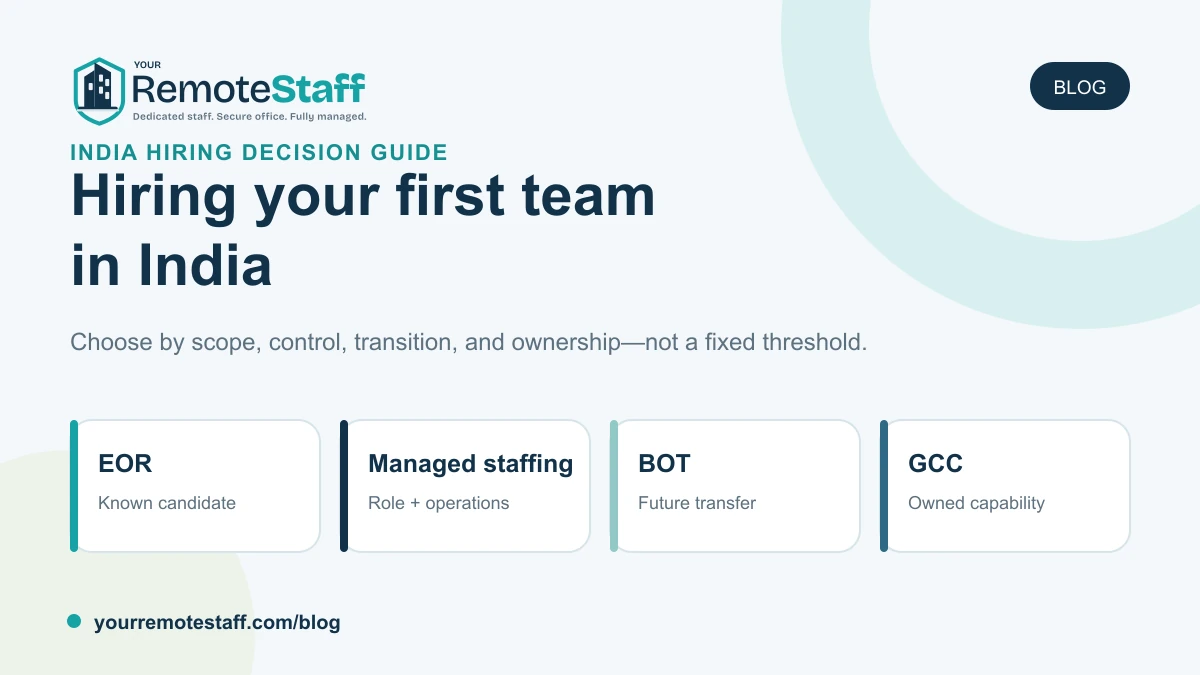
For a US small or midsize company hiring its first team in India, the choice is not simply “EOR or entity.” Four different models may enter the discussion: an Employer of Record (EOR), managed remote staffing, Build-Operate-Transfer (BOT), and a Global Capability Centre (GCC).
They solve different problems:
- EOR primarily supplies a local legal-employment layer.
- Managed staffing can combine recruiting with the employment and operating infrastructure around dedicated professionals.
- BOT is a contractual path in which a partner builds and operates a unit before an agreed transfer.
- GCC is an India-based capability that operates as an integral part of the parent company’s organization.
The best starting point depends on whether you already have candidates, which local functions your company can support, whether direct ownership is required, and how permanent India is in your operating strategy. A fixed headcount rule cannot answer all four questions.
Before comparing those models, use the dedicated remote staff readiness checklist to confirm that the underlying work has a recurring ownership lane, an internal manager, review capacity, planned access, and a complete operating budget. A different India structure cannot repair an undefined role or an unowned workflow.
This is a commercial decision framework
Employment, tax, corporate-presence, intellectual-property, data, and entity decisions depend on the facts and the applicable jurisdictions. Use this guide to organize the commercial requirement, then obtain advice from qualified US and India professionals before choosing a legal structure.
EOR, managed staffing, BOT, and GCC in plain English
These labels are often placed in one comparison table as though they were interchangeable products. They are not. Understanding the category of each model makes the decision clearer.
Employer of Record: a legal-employment structure
An Employer of Record generally employs a person through its local entity and administers the employment contract, payroll, withholding, statutory contributions, benefits, leave, and routine employment compliance. The client company directs the person’s day-to-day work.
An EOR can be a strong fit when:
- You have already selected the person
- The role will be distributed or home-based
- Your company can handle recruiting, equipment, access, IT support, management, and continuity
- The principal gap is local employment rather than team operations
EOR does not describe a universal bundle. Recruiting, background checks, laptops, workspace, IT, and replacement sourcing may be included, optional, partner-delivered, or outside scope. Use the India EOR scope checklist to audit the actual proposal and agreement.
Workday’s EOR overview↗ also describes the central division: the EOR is the legal employer for the covered employment responsibilities while the client directs daily work. Exact responsibilities still depend on the country and contract.
Managed staffing: talent plus an operating layer
Managed remote staffing is useful when the buyer starts with a role requirement rather than a selected candidate and needs a partner to supply more of the local operating system.
Depending on the provider and agreement, that may include:
- Role scoping, sourcing, and screening
- Interview and offer coordination
- Local employment, HR, payroll, and leave administration
- Office workspace
- Laptop, internet, and local IT support
- Attendance support and local escalation
- Retention and replacement support
The client still directs the work: tasks, priorities, tools, team communication, quality standards, and output review. The staffing provider manages the agreed employment and operational layer around the dedicated professional.
This is not project outsourcing. The provider does not automatically take ownership of a fixed deliverable or run the client’s function. The client adds dedicated capacity to its own workflow.
Build-Operate-Transfer: a path to future ownership
Build-Operate-Transfer is a contractual model in which a partner builds an operation, runs it for an agreed period or until agreed conditions are met, and then transfers the defined operation to the client.
A BOT discussion should specify:
- What is being built: a team, an operating unit, an entity, infrastructure, or a combination
- Which party owns the legal entities, employment relationships, leases, assets, systems, and contracts during each phase
- What “operate” includes and who directs business work
- What triggers transfer
- Which people, assets, contracts, data, intellectual property, and liabilities transfer
- How transfer pricing, employee consent, continuity, and post-transfer support are handled
ANSR’s Build-Operate-Transfer overview↗ describes BOT as a partner-led build and operating phase followed by transfer to the enterprise, often for a capability or captive center. ANSR is a BOT provider, so its description is useful category context—not a universal contract standard.
BOT is relevant when eventual ownership is an explicit requirement. If the buyer only needs several dedicated professionals and has no transfer objective, BOT may introduce a destination and transaction that the business does not yet need.
Global Capability Centre: an owned strategic capability
The Government of India’s Press Information Bureau defines GCCs as offshore units established by companies to deliver services for their parent organizations and function as integral parts of the global corporate structure. GCCs can support information technology, research and development, customer support, business operations, and other specialized functions. See the official overview, From Policy to Prosperity: GCCs Leading India’s Growth Journey↗.
A GCC is therefore more than a hiring method. It is an organizational commitment that may require:
- An appropriate India legal and tax structure
- Local leadership and governance
- Recruitment and employer branding
- Payroll, HR, benefits, and employment administration
- Office, equipment, network, IT, and security operations
- Finance, procurement, vendor management, audit, and reporting
- Long-term ownership of operating risk and capability development
An owned GCC can be appropriate when India is intended to become a strategic location rather than simply a source of the first few remote team members. The legal form, ownership, tax treatment, and operating setup require professional advice.
Quick comparison for a first India team
| Model | What it primarily solves | What the US company still needs to own or verify | Strong starting signal |
|---|---|---|---|
| EOR | Local legal employment and related administration | Candidate sourcing, daily management, workplace, equipment, IT, access, and continuity unless contracted | “We have selected the person; we need a local employer.” |
| Managed staffing | Recruiting plus an ongoing employment and operating layer | Daily work, priorities, tools, access decisions, feedback, and output review | “We know the role; we need a partner to recruit, seat, employ, and support the person.” |
| BOT | Partner-led setup and operation with a defined future transfer | Target-state design, governance, transfer requirements, acceptance criteria, and eventual ownership | “We intend to own the India operation, but need a partner to establish it.” |
| GCC | A strategic India capability integrated with the parent organization | Entity and operating structure, leadership, employment, finance, facilities, governance, and long-term risk | “India will be a durable owned part of our global operating model.” |
This table is a starting hypothesis, not a legal conclusion. Providers sometimes combine categories, and the agreement may allocate responsibilities differently from the label.
Which model fits your first India team?
Start with EOR when the person is known and the operating system already exists
EOR deserves serious consideration when your company has found the right candidate and can support everything around that person except local employment.
For example, your company may already have:
- A mature recruiting and interview process
- A distributed-work policy
- A device procurement and support program
- Identity, access, and security administration
- Managers experienced with international team members
- A continuity plan if the person leaves
In that situation, paying for a broader staffing and office layer may duplicate capabilities you already possess. Compare EOR providers on India-specific employment scope, contract terms, support, complete fees, and the responsibilities retained by your company.
Start with managed staffing when you have a role but not the India infrastructure
Managed staffing is the stronger candidate when you know the work you need done but do not have the person, local recruiting engine, workplace, equipment process, HR administration, or replacement capability.
It can be especially relevant for a US SMB that wants:
- A dedicated professional rather than a freelancer or shared resource
- Direct control over daily work
- Candidate choice before starting
- An office-backed setup
- One operating partner across recruiting, employment, workspace, hardware, IT, HR, payroll, attendance support, and continuity
- The ability to begin with one role and add seats as demand becomes clear
The critical diligence question is whether the provider truly owns those functions or merely refers the buyer to separate vendors. Review how office-based remote staffing works and turn the India staffing security guide into operational questions for each provider.
Start with BOT when transfer is part of the business case
BOT belongs in the shortlist when the intended destination is a client-owned operation and the company wants a local partner to build and stabilize it first.
That implies more than “we might want an entity someday.” The buyer should be able to describe:
- Why ownership matters
- What must transfer
- When transfer should become possible
- Which leaders will accept the operation
- How the client will run HR, finance, facilities, IT, and governance after transfer
- What commercial and legal conditions make the transfer acceptable
If those answers are not yet available, start by validating the role mix and operating rhythm. Do not pay for transfer complexity solely because ownership might become useful later.
Start with a GCC when India is already a strategic operating decision
A GCC becomes relevant when leadership has decided that India should be a durable, integrated capability with its own governance and long-term organizational mandate.
Signals can include:
- A multi-year India operating strategy approved by leadership
- A planned local leadership structure
- A requirement for direct control over employment policies and local operations
- A need to own contracts, leases, assets, or local commercial relationships
- Sufficient internal finance, legal, security, HR, and management capacity
- A capability mandate that extends beyond filling several open roles
Headcount matters to the economics, but it is not the only trigger. A smaller regulated or strategically sensitive unit may require deeper ownership, while a larger distributed team may still use third-party employment or staffing support. Model the actual facts.
Practical next step
Turn the decision framework into a role requirement your team can use.
Compare India team models→Use the India Team Readiness Matrix
Before requesting proposals, answer these eight questions. The pattern of answers will usually narrow the model faster than a provider feature list.
| Decision question | If the answer is yes | Model signal |
|---|---|---|
| Have we already selected the candidate? | Recruiting may be unnecessary | Consider EOR if local employment is the main gap |
| Do we need a partner to source and screen candidates? | The requirement starts with talent acquisition | Consider managed staffing, BOT, or an internally built GCC recruiting function |
| Do we need an office, hardware, internet, and local IT support? | Employment alone does not complete the setup | Favor a model with a contracted operating layer |
| Can our managers direct daily work across US and India hours? | Dedicated staffing can add capacity to the existing team | EOR or managed staffing may fit, depending on local support needs |
| Must the operation transfer to our ownership? | Transfer mechanics are central, not optional | Evaluate BOT |
| Must we directly own the India employment and operating structure now? | A third-party employment model may not satisfy the requirement | Evaluate an entity and GCC structure with counsel |
| Will the India operation sell, contract, invoice, or hold assets locally? | Corporate-presence and tax questions become more prominent | Obtain legal and tax advice before selecting the model |
| Can we support local leadership, HR, finance, facilities, IT, and governance? | Direct ownership may be operationally supportable | GCC or post-transfer BOT may be viable |
Turn the matrix into a responsibility map
For every required workstream, record:
- Required outcome: What must be true for the team member to work successfully?
- Named owner: Your company, the provider, or another partner?
- Contract reference: Where is that responsibility written?
- Included cost: Included, pass-through, optional, or separately contracted?
- Service expectation: What response, evidence, or escalation is expected?
- Exit or transition: What happens when the person leaves or the model changes?
Do this for recruitment, employment, payroll, benefits, office, devices, network, IT support, access, attendance, leave, retention, replacement, offboarding, and any future transfer.
Why universal headcount thresholds are unreliable
Search results frequently recommend one model below a particular number of hires and another model above it. Those figures can be useful hypotheses, but they are not universal decision rules.
Two companies with the same India headcount may need different models:
- One already has candidates, distributed-work infrastructure, and international HR support.
- The other needs recruiting, an office, laptops, local IT, attendance support, and replacement continuity.
- One wants a permanent owned product center.
- The other wants flexible dedicated capacity for an existing US-led function.
- One will contract with Indian customers.
- The other will only support its US business.
The economic crossover also changes with compensation, benefits, provider fees, office requirements, city, equipment, internal staffing, legal structure, and the cost of management time. Ask each provider to show assumptions, then have finance and counsel validate them.
Use a complete comparison:
Complete operating cost = compensation and benefits + provider fees + recruitment + workspace and equipment + IT and security operations + HR and payroll + local management and continuity + setup or transfer costs + retained internal workload
Do not compare an EOR platform fee with a managed-seat price or GCC budget until all three include the same required functions.
Four practical US-company scenarios
Scenario 1: a SaaS company has already found one specialist
A US SaaS company receives a strong referral for an India-based engineer. It already ships configured laptops internationally, supports distributed employees, manages identity and access, and has an experienced engineering manager.
The missing layer is local employment and payroll administration. An EOR may be the most direct fit. The company should audit India coverage and contract scope rather than buying recruiting and office services it does not need.
Scenario 2: an agency needs three dedicated roles but has no India operations
A US agency needs a developer, QA engineer, and designer. It wants all three working exclusively with its delivery team, but it has not sourced candidates in India and does not want to coordinate coworking, hardware, internet, local IT, payroll, leave, and replacement searches.
Office-backed managed staffing is a stronger starting hypothesis. The agency can interview and choose each candidate, direct client work and priorities, and use the provider for the local employment and operating layer.
The dedicated development team guide for digital agencies explains how to choose the first service lane, define client-access boundaries, structure the delivery workflow, and add roles from measured workload.
Scenario 3: a product company has committed to future ownership
A growing product company has approved an India engineering center as a long-term strategic capability. It wants the operation to become client-owned, but it does not yet have local setup leaders or a functioning India organization.
BOT may fit if the transfer objective, assets, employment transition, acceptance criteria, governance, and post-transfer support can be defined contractually. A general staffing arrangement without transfer terms would not satisfy the stated destination.
Scenario 4: an established enterprise is creating a strategic India capability
An enterprise has executive sponsorship, local leadership plans, finance and legal support, an approved operating mandate, and a long-term portfolio of functions for India.
That is a GCC decision rather than a first-hire workaround. The company may build directly or use partners for parts of setup and operation, but it should design the entity, governance, talent, facilities, security, and financial model as an integrated capability.
A staged path for a US SMB entering India
Not every company needs to choose its permanent India structure before the first role starts. A staged approach can preserve options without pretending that every model converts automatically into another.
Stage 1: define the work
Specify the first roles, required experience, working-hour overlap, manager, systems access, security needs, and measurable responsibilities. If nobody in the US organization can direct and review the work, changing the India hiring model will not solve the management gap.
Stage 2: define the operating requirement
Decide whether each person needs a managed office, standard hardware, specialized equipment, local IT, background checks, attendance support, or role-specific controls. Identify what the US company can reliably supply.
Stage 3: select the lightest complete model
Choose the model that covers the full current requirement without buying an unsupported future story:
- EOR when employment is the main missing layer
- Managed staffing when talent and local operations are also missing
- BOT when transfer is an approved destination
- GCC when direct strategic ownership is already required
“Lightest” does not mean the smallest invoice. It means the least organizational structure that still assigns every required responsibility.
Stage 4: prove the operating rhythm
Evaluate whether the role definition, management cadence, access model, communication, work review, local support, and continuity process function in practice. Document what needs to change before adding more roles.
Stage 5: define re-evaluation triggers
Revisit the model when facts change, such as:
- India becomes a strategic location rather than a staffing channel
- Local leadership is appointed
- Direct local contracts, revenue, leases, or asset ownership become necessary
- The organization wants direct employment-policy control
- Provider fees and internal operating costs change materially
- A formal transfer objective is approved
- Legal, tax, customer, investor, or regulatory requirements change
The next model should be triggered by a changed requirement, not an arbitrary anniversary.
What to compare before signing
Request a written responsibility and cost schedule from every provider. At minimum, compare:
Talent acquisition
- Who translates the role into a search brief?
- Who sources and screens candidates?
- Can your company interview and choose the person?
- What checks are performed?
- What happens after a rejected shortlist?
- Is replacement sourcing included?
Employment and people operations
- Which entity employs the person?
- Which payroll, benefits, leave, and statutory tasks are included?
- Who handles routine employee questions and local escalation?
- Which decisions require provider review or approval?
- What happens at resignation or termination?
Workplace and technology
- Where will the person work?
- Who owns, configures, repairs, replaces, and retrieves equipment?
- Who provides internet and local IT support?
- How are access and security responsibilities divided?
- Which controls are contractual and which are merely available?
Commercial structure
- What is included in the recurring price?
- Which costs are deposits, pass-throughs, or add-ons?
- How do compensation changes affect fees?
- What notice, exit, and replacement terms apply?
- Are foreign-exchange assumptions explained?
Ownership and transition
- Does the arrangement include any transfer right?
- If so, what transfers, under what conditions, and at what price?
- Which consents and legal steps may be required?
- Who owns work product, data, devices, and process documentation?
- What support continues after transfer?
Use the broader guide to choosing an India staffing partner to compare delivery evidence, operating scope, and contract clarity.
When proposals use different bundles or fee structures, apply the offshore staffing quote comparison checklist to normalize recurring costs, one-time charges, pass-throughs, retained buyer work, replacement, foreign exchange, notice, and exit terms.
Where YourRemoteStaff fits
YourRemoteStaff is an office-backed managed staffing model operated by Salt Technologies. It is designed for US companies that know the role they need but do not want to build the India recruitment, office, hardware, IT, HR, payroll, attendance, and replacement layer themselves.
The model works as follows:
- We help define the role, recruit, screen, and coordinate a shortlist.
- You interview and choose the candidate.
- The selected person is a dedicated professional working exclusively for your team, employed and managed by us in India.
- The professional works from our secure managed office with standard hardware and local IT support.
- You direct tasks, priorities, tools, workflow, feedback, and output review.
- We manage the agreed employment and operating layer, including HR, payroll, attendance support, leave coordination, local escalation, and replacement support.
It is not automatically the best fit:
- If you already selected a person and only need local employment administration, an EOR may be more direct.
- If you require a contractual transfer of the operation, evaluate a BOT structure rather than assuming a staffing agreement includes one.
- If India is already an approved owned strategic operation, design the GCC and entity path with qualified advisors.
- If you want a vendor to own a fixed project outcome, evaluate a managed delivery or project outsourcing model instead of dedicated staffing.
See how YourRemoteStaff works and review managed-seat pricing when you want to compare the complete operating layer.
Questions for your leadership team
Before asking sales teams for proposals, align internally on these questions:
- Are we hiring a known person or searching for a role?
- Who will manage daily work and review output?
- Which India recruiting capability do we already possess?
- Where should the person work?
- Who will supply and support devices, network, and access?
- Who will own local HR, attendance, leave, and escalation?
- What continuity do we need after resignation or poor fit?
- Do we need direct legal ownership now?
- Is future transfer a contractual requirement or only a possibility?
- Will the India operation sign local contracts, earn local revenue, lease space, or hold assets?
- Which complete costs and retained internal tasks will finance compare?
- What facts would trigger a move to a different model?
If leadership cannot answer these questions, delay the provider comparison—not the business requirement. A clear responsibility map will produce better proposals and expose gaps before they become operating problems.
Choose the current model and preserve the future option
For most US SMBs, the best first step is not “use EOR until a fixed headcount” or “build a GCC immediately.” It is to define the work, map every required employment and operating function, and select the lightest model that completely covers the current need.
Use EOR when the candidate and operating system are already in place. Use managed staffing when the role also needs recruiting and local infrastructure. Use BOT when eventual transfer is part of the approved strategy. Build a GCC when India is becoming an owned strategic capability.
To assess the practical fit, share your target roles, expected team shape, current India capabilities, office requirements, and ownership goals through the India team model consultation. We will explain where office-backed managed staffing fits and where a different model may be more appropriate.
Source notes and disclaimer
- Workday’s EOR guide, accessed 2026-07-13, supports the general distinction between legal employment administration and client-directed daily work. Provider contracts and India-specific scope vary.
- The Government of India Press Information Bureau publication From Policy to Prosperity: GCCs Leading India’s Growth Journey, published 2025-12-11 and accessed 2026-07-13, supports the GCC definition used here.
- ANSR’s Build-Operate-Transfer overview, accessed 2026-07-13, is used for general BOT category context. ANSR is a provider; its scope and claims do not define every BOT agreement.
- “Small and midsize company” is used here as a commercial audience description, not as a determination of eligibility under any U.S. Small Business Administration program.
- The India Team Readiness Matrix is an editorial commercial-planning framework. It is not legal, tax, accounting, employment, security, or investment advice.
Common questions