AT A GLANCE
What you’ll learn
- EOR describes a legal-employment structure, not a universal service bundle.
- Recruitment, screening, workspace, hardware, IT, and continuity require separate verification.
- Compare complete employment and operating scope rather than only the advertised EOR fee.
- Office-backed managed staffing can close operational gaps while the client continues to direct the work.
In this guide 10 sections
An EOR is a legal-employment model, not a universal service bundle
An Employer of Record (EOR) in India generally acts as the local legal employer and administers employment contracts, payroll, withholding, statutory contributions, benefits, leave, and employment compliance. Your company still directs the person’s day-to-day work.
Recruitment, candidate screening, office space, hardware, IT support, attendance operations, local escalation, retention support, and replacement sourcing are separate capabilities. A provider may include them, sell them as add-ons, deliver them through partners, or leave them to you.
The practical rule is simple: verify every function your hire needs in the proposal and contract. Do not assume the term “EOR” defines the complete operating scope.
The provider’s contract controls
Public product pages explain a general service. Your agreement, statement of work, country coverage, and local delivery model determine what is included for a specific India hire. Treat every checklist item below as a question to verify, not a claim about every EOR provider.
What an Employer of Record commonly covers
An EOR arrangement typically has three parties:
- The EOR is the local legal employer.
- The person performs work for your business.
- Your business directs daily responsibilities, priorities, and output.
Remote describes an EOR as a provider that acts as the legal employer and commonly handles HR administration, payroll, taxes, benefits, and local employment obligations while the client retains the day-to-day relationship. Deel similarly describes EOR as the legal-employment and compliance layer, with the client directing daily work. See Remote’s EOR explanation↗ and Deel’s EOR, PEO, and staffing guide↗.
The exact India responsibilities depend on the provider and agreement, but these functions are commonly central to EOR scope:
| Workstream | Common EOR role | What the buyer should verify |
|---|---|---|
| Local employment | Employ the person through an India entity and issue employment documentation | Which entity signs the agreement and whether the provider owns or partners for that entity |
| Payroll | Calculate and process salary in local currency | Payroll calendar, cutoff dates, corrections, expenses, payslips, and funding process |
| Tax and statutory administration | Withhold and remit applicable payroll deductions and contributions | Which filings and contributions apply to the person and work location |
| Benefits | Administer mandatory and selected supplemental benefits | What is included, optional, standardized, or separately charged |
| Leave and routine HR | Maintain leave records and support routine employment administration | Policy ownership, response times, employee support channels, and escalation |
| Employment changes | Process approved compensation, title, or contract changes | Notice, documentation, price, and approval workflow |
| Offboarding | Support locally appropriate employment termination or resignation administration | Notice, final payroll, equipment return, data access, and legal-review responsibilities |
This is general commercial information, not legal or tax advice. India employment requirements can vary by location, role, compensation, and circumstances. Use qualified India counsel for legal conclusions.
What may sit outside the core EOR scope
The following functions are important to a successful remote hire, but they are not inherent in the EOR label:
| Capability | Possible provider treatment | The gap if nobody owns it |
|---|---|---|
| Candidate sourcing | Included, add-on, partner-delivered, or client-owned | No qualified candidate pipeline |
| Skills and communication screening | Add-on or separate recruitment service | The legal hiring structure exists, but role fit remains unverified |
| Background and reference checks | Included at a defined level, optional, or third-party | Screening expectations may not match the role’s risk |
| Office or coworking space | Optional, partner-delivered, or unavailable | The buyer must arrange and support the workplace |
| Laptop and equipment | Purchase, lease, allowance, add-on, or client-owned | Procurement, setup, shipping, repair, and return remain unassigned |
| IT and network support | Limited help desk, separate service, or client-owned | Access and device problems can become the client’s operating burden |
| Attendance and schedule operations | HR record only or broader local support | US-hours coverage and schedule escalation may lack an owner |
| Local supervision and escalation | Varies widely | Performance concerns may have no local operational path |
| Retention and engagement | Basic HR support, add-on, or client-owned | The buyer must create the retention and communication rhythm |
| Replacement sourcing | Separate capability; may be included, added, partner-delivered, or unavailable | Resignation or poor fit can restart recruiting if continuity is unassigned |
| Knowledge-transfer continuity | Client-owned unless specifically contracted | Product context may leave with the person |
Recruitment and legal employment solve different problems
If the constraint is “we cannot find the right person,” you need a sourcing and screening capability. If the constraint is “we already found the person but need a local legal employer,” EOR may be exactly the right tool. Some providers bundle both, but buyers should verify each function separately.
Toku’s EOR-vs-staffing guide↗ describes the same core distinction: staffing primarily addresses sourcing and placement, while EOR primarily addresses legal employment and local compliance. Toku is also a vendor, so use the explanation as a scope prompt—not independent legal authority.
Why India scope needs country-specific verification
An India EOR proposal should explain how the provider determines and administers the rules that apply to the employing entity, person, compensation, and work location.
For example:
- The Employees’ Provident Fund Organisation publishes employer guidance↗ on establishment coverage, registration, returns, and contributions.
- The Employees’ State Insurance Corporation publishes coverage guidance↗ showing that applicability depends on establishment, location, and wage conditions.
- India’s Press Information Bureau states that the four Labour Codes became effective on November 21, 2025. The Ministry of Labour and Employment subsequently notified several Central Rules on May 8, 2026; its published FAQs also distinguish establishments governed by Central Rules from those governed by state rules. See the official labour-code announcement↗, Code on Wages Central Rules notification↗, and Ministry FAQs↗.
These examples are not a checklist of everything that applies to one hire. They show why a generic global feature list is insufficient. Ask the provider to document the India-specific basis for payroll, contributions, benefits, leave, and employment administration, and obtain qualified advice for your circumstances.
Run the EOR Scope Gap Audit
Before comparing provider fees, map the complete work required to make the hire successful.
1. Legal employer and contract
Record:
- The India entity that will legally employ the person
- Whether that entity is owned by the provider or supplied through a partner
- The agreement that governs employment
- The responsibilities retained by your company
- The process for contract changes, disputes, resignation, and offboarding
If the legal-employer relationship or responsibility split is unclear, stop and obtain qualified advice before moving forward.
2. Payroll, tax, benefits, and statutory administration
Confirm:
- Salary currency and payroll schedule
- Funding deadlines and foreign-exchange treatment
- Payroll corrections and expense reimbursement
- Applicable deductions and contributions
- Mandatory and supplemental benefits
- Payslips and buyer reporting
- Leave records and employment-policy administration
- Fees or deposits beyond the advertised service charge
Do not compare only the platform fee. Compare the complete funded employment cost plus every operating capability you still need to supply.
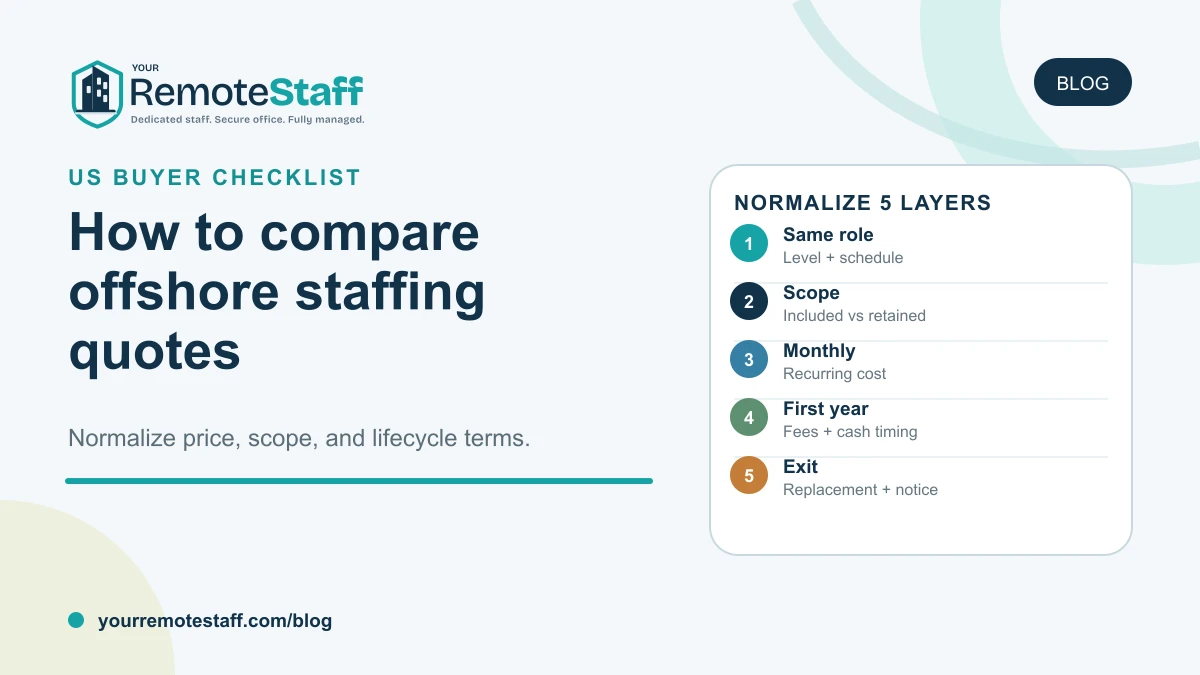
If you are reviewing multiple proposals, use the offshore staffing quote comparison checklist to separate recurring costs, one-time fees, deposits, pass-throughs, buyer-owned work, foreign-exchange treatment, replacement, and exit terms.
3. Recruitment and screening
Ask who will:
- Turn the business requirement into a role brief
- Source candidates in India
- Validate technical or functional skills
- Assess communication and remote-work readiness
- Conduct references and appropriate background checks
- Coordinate interviews and offers
- Restart the search after a rejected shortlist
An EOR may support some or all of this, but it is a separate question from whether the provider can legally employ the person.
4. Workspace, hardware, network, and IT
Confirm:
- Where the person will work
- Who procures, configures, and replaces the laptop
- Who supplies monitors or role-specific devices
- Who provides internet and local IT support
- How security controls are implemented
- Who supports device return and access removal
- Which costs are included, passed through, or separately invoiced
For buyers that need an office-based model, “remote employee” is not enough detail. Verify the actual workplace, network, access process, and support owner. See the guide to office-based remote staff in India.
Use the India remote staffing security guide to turn device, network, access, and incident expectations into provider questions. Employment compliance does not replace the client’s security governance.
5. Attendance, local operations, and continuity
Confirm:
- Who records and follows up on attendance
- How working-hour or shift concerns are escalated
- Who coordinates leave with the client team
- Who handles local workplace issues
- What support exists for retention and engagement
- What happens if the person resigns
- Whether replacement sourcing is included
- How knowledge transfer and access handover are handled
EOR employment administration and day-to-day project management are different responsibilities. Your company should continue to own tasks, priorities, feedback, and work acceptance unless a separate managed service says otherwise.
Score the audit: red, amber, or green
For every required workstream, record:
- Required? Does this hire actually need it?
- Named owner: Provider, your company, or another partner
- Contract reference: Where is the responsibility written?
- Commercial treatment: Included, pass-through cost, add-on, or separate contract
- Service expectation: Response time, evidence, or escalation path
- Fallback: What happens if the service fails or the person leaves?
Use these statuses:
- Red: A required employment, payroll, statutory, liability, or access responsibility is unclear.
- Amber: An operationally important function has no named owner, price, or service expectation.
- Green: The required function is assigned, priced, evidenced, and reflected in the agreement.
The audit is not a legal opinion or a provider score. It is a way to expose unowned work before the first day.
Practical next step
Turn the decision framework into a role requirement your team can use.
Audit your India hiring setup→Twelve questions to ask an India EOR provider
Use these questions alongside the broader guide to choosing an India staffing partner. The goal is not to reward the longest feature list; it is to establish who owns every function your hire requires.
1. Which India entity will legally employ the person?
Ask for the legal entity name and clarify whether it is provider-owned or partner-operated. Understand which party is accountable for employment administration and where support is delivered.
2. Which employment, payroll, tax, and statutory tasks are included?
Request a country-specific responsibility schedule. Avoid relying only on a global feature list.
3. How are India and location-specific requirements identified?
Ask who determines which rules apply to the person’s work location and circumstances, how changes are monitored, and when the provider recommends external legal advice.
4. What benefits and leave administration are included?
Separate mandatory benefits, provider-standard benefits, optional benefits, and client-selected additions. Confirm administration fees and funding.
5. What is the complete monthly and lifecycle cost?
Ask about:
- Setup fees
- Deposits or reserves
- Payroll funding
- Benefits
- Foreign-exchange treatment
- Hardware or equipment
- Background checks
- Contract changes
- Offboarding and final payroll
- Optional support services
6. Are candidate sourcing and shortlist creation included?
If yes, confirm recruiter ownership, target roles, expected process, replacement search, and any separate fee. If no, name the recruiting owner before signing the EOR agreement.
7. Which screening activities are included?
Clarify skills testing, communication assessment, employment references, identity checks, and role-appropriate background checks. “Screened” should have a defined scope.
8. Who supplies and supports the workplace and equipment?
Verify office or coworking options, laptop ownership, configuration, repair, replacement, internet, peripherals, and equipment return.
9. Who handles IT, access, and security operations?
Clarify device controls, local help desk, account provisioning support, access removal, incident escalation, and responsibilities that remain with your internal IT or security team.
10. How are attendance, working hours, leave, and local escalation handled?
Payroll attendance records may not be the same as operational schedule support. If the role needs US-hours overlap or specific coverage, define how that expectation is coordinated and escalated.
11. What happens after resignation or poor fit?
An EOR can administer the employment exit, but replacement sourcing is a different capability. Confirm whether a new search is included, separately charged, or entirely your responsibility.
12. Which risks and approvals remain with our company?
Ask the provider to state the client-retained responsibilities plainly. Review responsibility for daily management, performance decisions, termination instructions and approvals, access governance, intellectual property and confidentiality, data processing, workplace conduct, insurance, indemnities, limitation of liability, and tax questions outside the EOR service.
How to interpret the scope gaps
The audit should reveal what remains unowned; it does not automatically select a model.
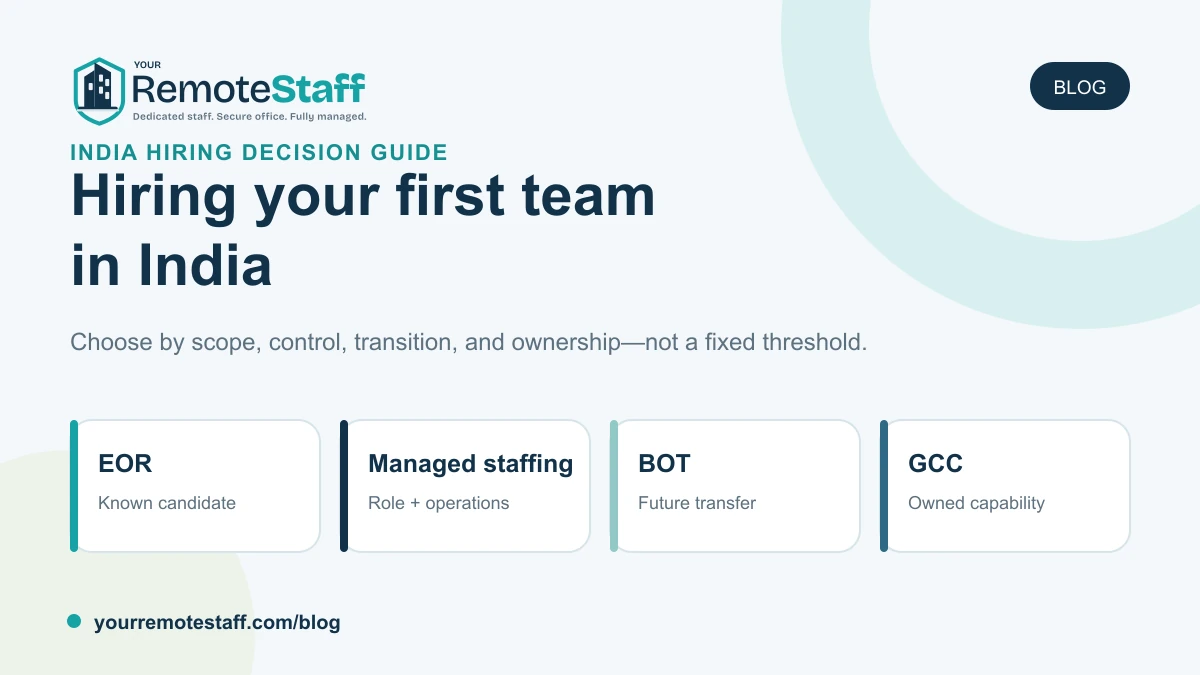
If you have not chosen a structure yet, use the first India team model guide to compare EOR, managed staffing, BOT, and GCC against your candidate readiness, operating requirements, ownership goals, and transfer plans.
- If the open items are local employment, payroll, benefits, and employment administration for a person you already selected, evaluate whether the EOR agreement closes those gaps.
- If recruitment, screening, workspace, hardware, IT, attendance support, local escalation, and replacement continuity also remain open, assign those functions to your internal team, another vendor, or a provider with a broader managed scope.
- If you need one employment layer across several countries, evaluate whether the provider’s country coverage and support model remain consistent.
- If India requires a managed workplace or a deeper local operating layer, assess that India requirement separately rather than assuming a global platform feature applies.
This is where YourRemoteStaff’s model is relevant. YourRemoteStaff is operated by Salt Technologies. The dedicated professional is employed and managed by us in India and works exclusively with your team. You interview and choose the candidate, then direct daily tasks, priorities, tools, and output review. We manage recruitment support, office workspace, standard hardware, IT, HR, payroll, attendance support, and replacement support around the seat.
That broader scope can close operational gaps left outside an EOR proposal. It does not make managed staffing universally better: if you already selected the person and arranged the required workplace, equipment, IT, management, and continuity support, a focused EOR service may be the more direct answer.
Review how office-backed remote staffing works and current managed-seat pricing when you want to compare the whole operating requirement rather than one service fee.
Decide from the complete requirement
Before choosing:
- Define the work and the person or role you need.
- List every employment and operational function required.
- Run the EOR Scope Gap Audit against the proposal and agreement.
- Assign and price every uncovered function.
- Compare the complete operating model—not only the headline fee.
If you need help mapping the India role, office, hardware, IT, HR, payroll, and continuity layer, compare your hiring options. If your finance or legal team is still asking whether a local company is necessary, start with the guide on hiring in India without your own entity.
Frequently asked questions
What does an EOR normally include in India?
An EOR commonly acts as the local legal employer and administers employment contracts, payroll, withholding, statutory contributions, benefits, leave, and routine employment compliance. Exact scope varies, so verify country-specific services and contract terms.
Does an EOR recruit candidates?
Recruitment is not inherent in the EOR model. Some providers offer recruiting directly, through partners, or as an add-on; others expect the client to bring a selected candidate. Confirm sourcing, screening, and replacement terms separately.
Are background checks included in EOR services?
They may be included, optional, partner-delivered, or separately priced. Confirm which identity, employment, education, criminal, or role-specific checks are available and appropriate for the role and location.
Does an EOR provide a laptop or office?
Some providers offer equipment or workspace services, but these are not universal EOR functions. Verify procurement, ownership, configuration, support, repair, replacement, return, office location, and all related fees.
Who manages the person’s daily work?
The client company generally directs daily work, priorities, tools, and performance feedback. The EOR manages the local employment responsibilities assigned in the agreement.
Does using an EOR remove every legal or tax risk?
No. An EOR agreement does not determine the buyer’s complete legal or tax position. Ask the provider to identify retained responsibilities, then use jurisdiction-specific counsel for employment, tax, data, intellectual-property, or corporate-presence questions.
What happens when an EOR-employed person resigns?
The EOR can administer the employment exit under the agreement and applicable requirements. Finding and screening a replacement is a separate service unless the provider contract explicitly includes it.
Source notes and disclaimer
- Remote’s public EOR guide (accessed 2026-07-13) is used for the general legal-employer, payroll, HR, tax, benefits, and client-management description.
- Deel’s public EOR, PEO, and staffing guide (updated 2026-06-09; accessed 2026-07-13) is used to distinguish employment administration from recruiting and placement.
- Toku’s public EOR-vs-staffing guide (updated 2026-04-28; accessed 2026-07-13) is used for the distinction between talent sourcing and legal-employment infrastructure.
- EPFO employer guidance, ESIC coverage guidance, the Government of India’s November 21, 2025 labour-code announcement, Ministry FAQs, and May 8, 2026 Central Rules notifications (accessed 2026-07-13) are used only to demonstrate why India payroll and employment scope needs current country-, authority-, state-, and circumstance-specific verification.
- Vendor pages are self-descriptions, not independent legal authority. Availability, local delivery, and contract scope must be verified directly.
- The EOR Scope Gap Audit is an editorial due-diligence framework. It is not legal, tax, compliance, insurance, or employment advice and does not rank providers.