AT A GLANCE
What you’ll learn
- Recurring workload and a qualified internal manager are hard readiness gates.
- Define one coherent outcome, quality standard, and review owner before recruiting.
- Map systems access, permissions, collaboration windows, and onboarding before day one.
- Budget for the complete operating requirement rather than comparing unlike task and seat prices.
- Use a preparation sprint or another model when the readiness scorecard reveals material gaps.
In this guide 17 sections
The short answer: readiness is an operating question
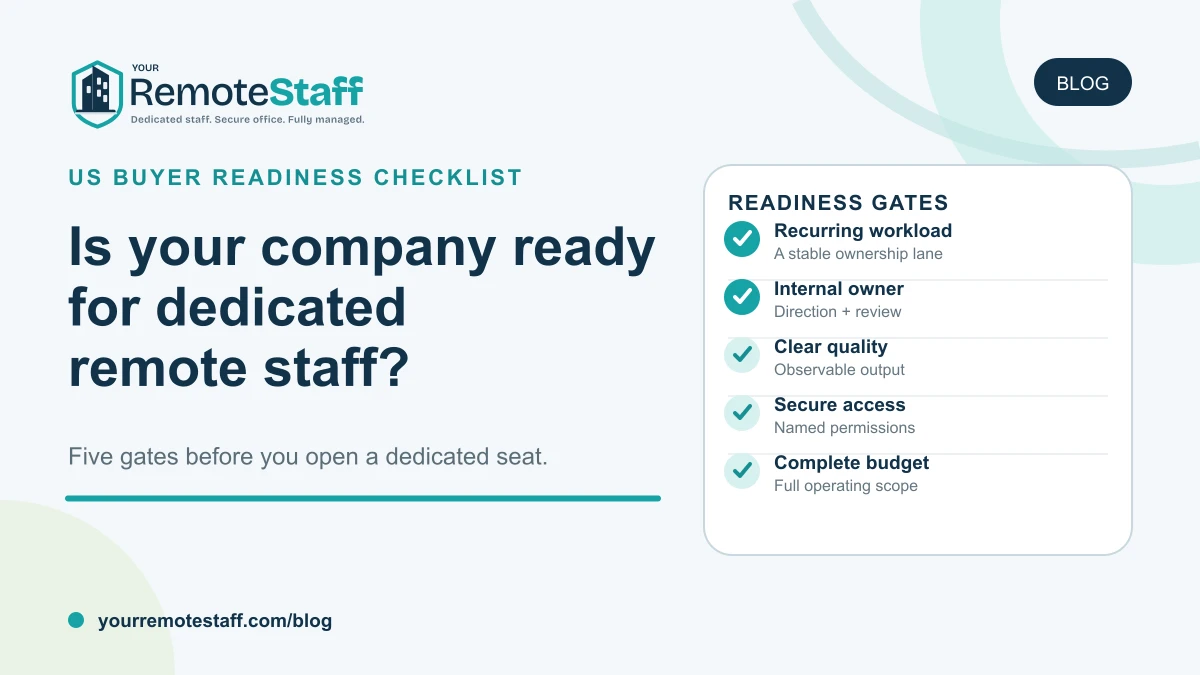
Your company is ready for dedicated remote staff when six conditions are true at the same time:
- You have recurring work that can keep a full-time role productively occupied.
- Someone inside your company can direct priorities and review the work.
- The role has a clear outcome, boundaries, and observable quality standard.
- The work can be delivered through approved digital systems with planned access.
- Your team can support a predictable communication and feedback rhythm.
- The budget covers a complete dedicated seat, not only an hourly task estimate.
Being busy is not enough. A dedicated remote professional adds stable execution capacity to an operating system your company still owns. If the work is occasional, nobody can manage it, or you want a vendor to take responsibility for a fixed project outcome, another arrangement may fit better for now.
Who this checklist is for
This checklist is for US small and midsize business owners, agency leaders, founders, and functional managers considering a dedicated remote role. Use it to assess whether your workload, management capacity, systems access, budget, and operating processes are ready before recruiting.
This guide therefore focuses on buyer readiness for dedicated remote staffing, especially an office-backed seat in India—not remote work in general.
What “dedicated remote staff” means
A dedicated remote staff member is a named professional who works exclusively with one client team in an ongoing role. The client directs daily work, priorities, tools, quality standards, and feedback. A staffing partner may recruit and employ the person and manage the agreed workspace, hardware, IT, HR, payroll, attendance, and local-support layer.
Three parts of that definition matter.
Dedicated
The professional is assigned to your team rather than rotating across several client accounts. That makes the model suitable for work where product, customer, brand, codebase, workflow, or company context compounds over time.
Remote
The work is delivered through digital systems from another location. Remote does not automatically mean home-based. In an office-backed model, the professional works from a managed office with standard hardware, local IT support, and an operating team around the seat.
Staff
The person joins your ongoing workflow. Your company remains responsible for deciding what work matters and whether the output is acceptable. This is different from asking a vendor to independently deliver a fixed project under a statement of work.
At YourRemoteStaff, the selected professional is employed and managed by us in India, works exclusively with your team from our secure managed office, and follows your priorities. You interview and choose the person. We manage the agreed recruitment and employment infrastructure while you direct the business work.
First apply the five hard readiness gates
These gates should be passed before comparing resumes or provider proposals. If one is missing, fix it or choose a different model rather than expecting recruitment to solve the operating gap.
Gate 1: The work is recurring enough for a dedicated seat
A dedicated role needs a continuing workload, not a temporary burst.
Look back over the previous 8–12 weeks:
- Which tasks appeared every week or month?
- Which queue kept growing?
- Which work repeatedly lost priority because an owner was overloaded?
- Which responsibilities require accumulated company context?
- Which handoffs created delay or rework?
- Which work will still exist after the current launch, migration, campaign, or busy season?
Examples of recurring lanes include:
- Maintaining and improving a WordPress or Shopify portfolio
- Building product features against an ongoing roadmap
- Running regression and release-quality workflows
- Executing an approved SEO and content program
- Managing paid campaigns and weekly reporting
- Maintaining bookkeeping and accounts-support processes
- Coordinating executive or operational administration
- Handling a stable support or research queue
One website build, one audit, one migration, or several hours of occasional assistance usually does not create a full seat by itself. A project or specialist engagement may be more appropriate until the work becomes repeatable.
Do not turn uncertainty into a full-time job description
A long wish list is not the same as recurring work. “Help with marketing, operations, customer support, research, design, and anything else” hides five different workflows. Group the real work, then choose one coherent ownership lane.
Gate 2: A qualified internal owner can direct the work
The client company needs one accountable person who can:
- Set priorities
- Explain the business context
- Resolve conflicting requirements
- Approve access
- Review output
- Give timely feedback
- Make trade-offs
- Escalate security, customer, legal, or commercial questions
The owner does not need to perform the role. They do need enough authority and subject understanding to judge whether the work is useful.
For an engineering role, that may be a technical founder, engineering manager, or qualified technical lead. For marketing, it may be a founder, marketing director, or channel owner. For operations, it may be an operations manager or executive who owns the process.
If nobody can manage the role, adding a remote person often increases coordination work without reducing the underlying constraint. The first need may be leadership, process ownership, or a managed project—not more execution capacity.
Gate 3: The role has one understandable ownership lane
A role is ready when you can complete this sentence:
We need a dedicated [role] to own [recurring outcome] because [current constraint] is delaying [business priority].
Examples:
- We need a dedicated WordPress developer to own maintenance and improvement work across our active client sites because the recurring queue is delaying launches and retainers.
- We need a QA automation engineer to own regression infrastructure and repeatable release checks because manual verification is consuming development capacity.
- We need a digital marketing specialist to coordinate foundational weekly execution because approved work across several channels has no accountable owner.
- We need an executive assistant to own recurring scheduling, preparation, follow-up, and operating administration because those tasks are displacing leadership work.
The sentence should describe ownership, not only software:
- Weak: “React, Node.js, AWS, Jira.”
- Stronger: “Own customer-facing workflow improvements from the React interface through the supporting API, inside our existing review and release process.”
If the role combines unrelated outcomes that require different expertise, split the requirement or rank the work. The first dedicated seat needs a coherent week.
Gate 4: The work can be reviewed and measured
Remote staff need a visible definition of acceptable work.
That does not mean every role needs one simplistic numerical target. It means the team can observe:
- What was assigned
- What was completed
- What is blocked
- Whether the output meets an agreed standard
- How quickly reviews happen
- Which rework or errors recur
- Whether the original queue is shrinking
- What should change next
Useful role evidence varies:
| Role type | Observable work evidence |
|---|---|
| Developer | Accepted work items, code review, tests, release behavior, documentation, and production feedback |
| QA professional | Risk coverage, useful defects, reliable test feedback, suite health, and release-readiness evidence |
| Designer | Approved flows and assets, design-system fit, handoff quality, revision patterns, and user/business constraints addressed |
| Marketing specialist | Approved campaigns or content, operating cadence, data quality, documented experiments, qualified demand signals, and next actions |
| Finance support | Timely reconciliations, complete records, review exceptions, documented controls, and closing-process reliability |
| Executive or operations support | Queue visibility, scheduling accuracy, prepared materials, documented follow-up, and escalation quality |
Avoid making the remote person responsible for outcomes they cannot control alone. A developer does not control product-market fit. A marketer does not control the offer, sales follow-up, or every conversion dependency. A bookkeeper does not set accounting policy. Define both contribution and decision boundaries.
Gate 5: The company can fund the complete operating requirement
A dedicated seat is a recurring capacity decision.
Budget for the whole requirement:
- Role and seniority
- Recruitment and screening
- Workspace
- Hardware and setup
- IT support
- HR and payroll
- Attendance and leave operations
- Provider support
- Replacement and continuity provisions
- Specialized software or equipment
- Any schedule or role-specific requirements
- Internal management time
Do not compare only an hourly task estimate with a complete monthly seat. They buy different forms of capacity.
Review current monthly seat pricing after the role and operating requirement are clear. The useful question is not merely “What is the lowest monthly number?” It is “Can this seat productively own enough recurring work to justify the complete commitment?”
Use the ten-dimension readiness scorecard
Mark each dimension green, yellow, or red.
- Green: ready and owned
- Yellow: fixable before recruiting or during a short preparation period
- Red: a material model or operating gap
Do not add the colors into a magic score. Some dimensions are hard gates. Ten greens cannot compensate for having no recurring work or no qualified manager.
| Readiness dimension | Green | Yellow | Red |
|---|---|---|---|
| Recurring workload | A stable weekly/monthly queue exists | Demand is likely but not yet organized | Work is one-time, sporadic, or speculative |
| Role ownership | One coherent outcome and boundary | Scope needs narrowing | The description combines unrelated jobs |
| Internal manager | Named owner with authority and review capacity | Owner exists but feedback time is constrained | Nobody can direct or judge the work |
| Work visibility | Priorities and status live in a shared system | Tools exist but are inconsistently used | Work depends on memory, chat, or verbal requests |
| Quality standard | Examples, acceptance criteria, or controls exist | Standards are partly implicit | “We will know it when we see it” |
| Remote deliverability | Work and required collaboration can happen digitally | Some process changes are needed | Physical presence or local licensing is essential |
| Access readiness | Systems, owner, permissions, and removal are mapped | Access list exists but controls need work | Shared credentials or unknown data exposure |
| Collaboration rhythm | Required overlap and async practices are defined | Schedule is plausible but untested | Expectations require continuous US presence without planning |
| Onboarding inputs | Documentation, first backlog, and contacts are ready | Material exists but is fragmented | The hire must reverse-engineer the company alone |
| Complete budget | Full seat and internal support are approved | Budget range exists but scope is unsettled | Funding assumes occasional task pricing |
How to interpret the pattern
Mostly green, with no hard-gate reds: begin role scoping and provider evaluation.
Several yellows: run the readiness sprint later in this guide before recruitment starts.
Red recurring workload: use a bounded project or flexible specialist support until demand repeats.
Red internal manager: establish functional ownership or obtain managed leadership first.
Red remote deliverability: keep the role local or redesign only the portions that can be delivered remotely.
Red access readiness: stop and design the security and approval model before granting production, financial, customer, health, or sensitive-data access.
Which US buyers are most likely to be ready?
Company size alone is not the answer. A five-person agency with a stable client lane may be more ready than a 200-person company with no owner for the proposed role.
A small digital agency with repeatable delivery work
The agency may be ready when:
- The same platform or service lane sells repeatedly
- Work can keep one role productively assigned across an approved client portfolio
- An agency owner controls scope, priorities, review, and acceptance
- Client contracts permit the staffing and access arrangement
- Repositories, accounts, and data can be separated appropriately
A dedicated WordPress developer, front-end developer, QA professional, designer, or marketer can add named capacity inside the agency’s workflow. The agency still owns client promises and delivery decisions.
Use the dedicated development team guide for digital agencies when the readiness decision is specifically about an agency delivery pod.
A product company with a persistent engineering constraint
The product company may be ready when:
- A roadmap and technical owner already exist
- Work repeatedly queues in one layer or capability
- The codebase, environment, and review process are documented enough to onboard
- Repository and production access can be scoped
- The team has capacity to review the first month
The correct first role might be full-stack, front-end, back-end, platform-specific, data, mobile, or QA. Use the first remote engineering team guide to choose the role after the company passes the broader readiness gates.
A founder-led company with recurring marketing execution
The company may be ready when:
- The founder can still own audience, offer, positioning, and approvals
- Approved channel work repeats every week
- One person can have a coherent lane
- Website, content, data, creative, and campaign inputs are available
- Reporting can inform real decisions
If nobody owns marketing direction, the first need may be a qualified marketing leader rather than a remote execution role. The remote digital marketing team guide distinguishes a generalist from SEO, PPC, content, social, email, and link-building roles.
A professional-services firm with a stable operating queue
A law, accounting, consulting, healthcare, real-estate, or other professional-services firm may be ready when:
- Recurring administrative or operational work is documented
- A licensed or accountable US professional retains decisions that cannot be delegated
- Client confidentiality and system access are mapped
- The remote role has clear escalation rules
- The provider and company can support the required controls
Do not infer regulatory or security suitability from the job title. Evaluate the actual data, systems, contracts, jurisdictions, and professional obligations with qualified advisors.
An overloaded owner with no documented process
Overload is a signal, but not sufficient readiness.
If every task lives in the owner’s head, begin by recording:
- What repeats
- What decisions only the owner can make
- What information a teammate needs
- What acceptable output looks like
- What should be escalated
- Which systems and permissions are required
The owner does not need a perfect operating manual. They do need enough clarity to transfer a coherent lane rather than a stream of unexplained interruptions.
Build a recurring-work inventory
Before writing a job description, inventory the work.
Create five columns:
| Work item | Frequency | Current owner | Required context/access | Review or acceptance owner |
|---|---|---|---|---|
| Example: publish approved website updates | Weekly | Agency owner | CMS, staging, design file, client notes | Agency technical lead |
| Example: reconcile operating accounts | Monthly | Founder | Accounting system, bank feed, policy | US finance owner |
| Example: prepare campaign performance summary | Weekly | Marketing manager | Ad platforms, analytics, CRM | Marketing director |
Then classify each item:
- Role work: belongs in the dedicated seat.
- Manager decision: remains with your company.
- Provider operation: may be handled by the staffing partner.
- Project work: temporary and should not define the permanent seat.
- Eliminate or automate: should not be transferred as-is.
Estimate productive capacity honestly
Do not assume every paid hour becomes output. A real role includes:
- Planning
- Meetings
- Learning
- Documentation
- Review and revision
- Coordination
- Training
- Leave and normal interruptions
The purpose of the inventory is not to pack every minute. It is to confirm that a coherent, recurring lane exists and that the hire will not spend most of the week waiting for direction.
Look for context that compounds
Dedicated staff are particularly useful when performance improves through accumulated context:
- Understanding a product and codebase
- Learning an agency’s client portfolio and delivery standards
- Absorbing a brand voice and audience
- Knowing a recurring finance or operations process
- Building relationships with internal stakeholders
- Maintaining a test system or documentation base
If each assignment is unrelated and begins from zero, dedicated capacity may provide less value than a project-based specialist.
Choose the role only after confirming readiness
The readiness decision comes before the title.
Use three filters.
Filter 1: What outcome needs one accountable owner?
Name the recurring outcome, not a collection of tasks.
Examples:
- Maintain and improve a portfolio of websites
- Own a defined product-delivery lane
- Maintain repeatable release-quality evidence
- Run an approved content-production system
- Keep finance records complete and review-ready
- Protect executive focus through dependable operating support
Filter 2: How much ambiguity must the person resolve?
Seniority should match:
- Unclear versus defined work
- Decision authority
- Production or financial risk
- Review availability
- Stakeholder complexity
- Need for mentoring or standards
If work is bounded, patterns exist, and review is available, a mid-level professional may fit. If the role must translate ambiguous goals into plans, make higher-risk decisions, or improve standards, the seat may require senior capability.
The mid-level versus senior developer guide applies this reasoning to engineering. Use the same principle in other functions: years and titles are inputs, while ownership and judgment define the actual requirement.
Filter 3: Does one person have a coherent week?
Combine responsibilities only when they share:
- The same business outcome
- Related tools and expertise
- Similar review owners
- Compatible schedules
- Enough recurring demand
A full-stack developer may coherently own connected product work across layers. A digital marketing generalist may coherently coordinate several foundational channels. An executive assistant may combine scheduling, meeting preparation, follow-up, and operating administration.
Combining software development, paid media, bookkeeping, and customer support is not a coherent generalist role.
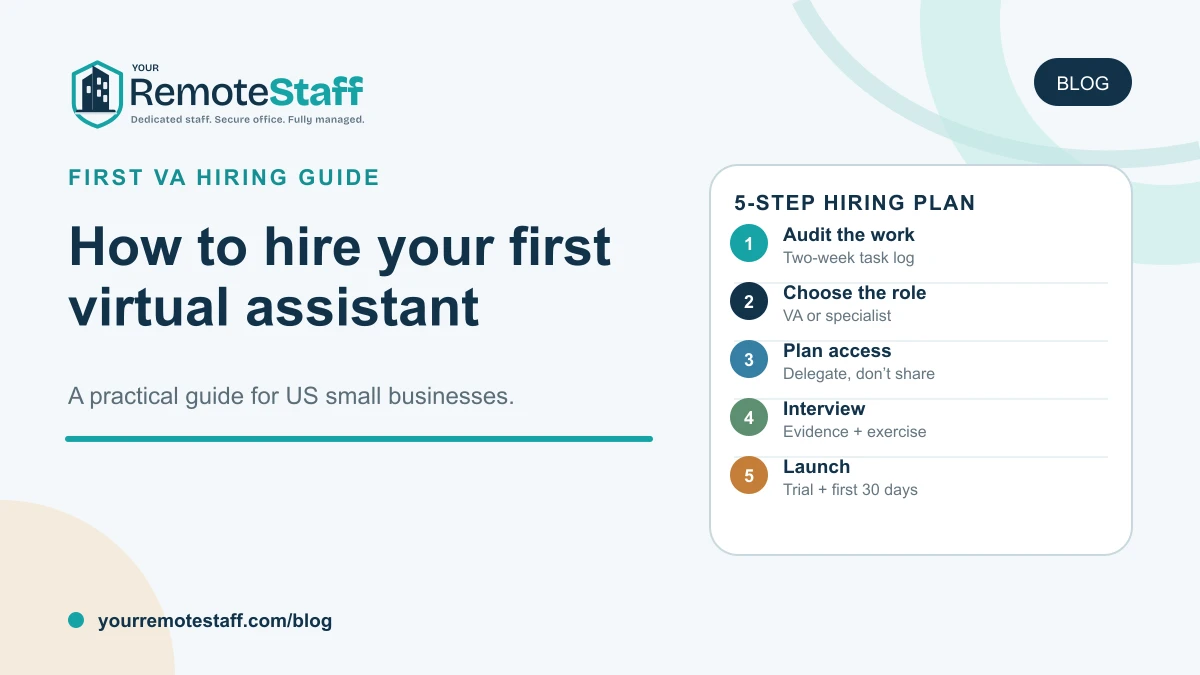
If recurring inbox, calendar, CRM, and follow-through work forms the first coherent lane, use the first virtual assistant hiring guide to audit tasks, choose the right assistant role, prepare access, interview candidates, and plan the first month.
Practical next step
Turn the decision framework into a role requirement your team can use.
See how office-backed staffing works→Confirm the role can work remotely
Most digitally delivered knowledge work can be performed remotely, but each role has different collaboration and access needs.
Map physical dependencies
Ask whether the role requires:
- Handling physical inventory or equipment
- In-person customer or patient contact
- Local licensing or signatory authority
- On-site inspections
- Direct access to a location-specific secure environment
- Continuous physical collaboration that cannot be redesigned
If only part of the role is digitally deliverable, separate that lane rather than pretending the entire job is remote-ready.
Define collaboration windows from the work
Do not start with “our hours” as a vague requirement. List when live overlap is needed:
- Prioritization
- Customer or client meetings
- Technical review
- Campaign or creative approval
- Pairing or training
- Financial review
- Release coordination
- Escalation
Routine execution, documentation, and status can often happen asynchronously. Decisions, relationship-building, and urgent blockers may need live overlap.
Use the US–India time-zone guide to design the schedule from actual collaboration events. Confirm extended or night-shift requirements before recruitment because schedule materially affects candidate fit and operating cost.
Design feedback before hiring
Specify:
- Who reviews the work
- What needs approval
- What can be completed independently
- Expected response time
- What evidence should accompany a request
- How disagreements are resolved
- When a blocker becomes an escalation
Remote teams do not fail merely because people are in different places. They struggle when priority and feedback are invisible.
Prepare access and security before day one
Access readiness is part of role readiness.
Create a simple access register:
| System | Business owner | Required permission | Approval needed for | Removal owner |
|---|---|---|---|---|
| Source repository | Technical owner | Role-specific project access | Protected branches, production, or admin changes | Technical owner |
| CMS or website | Website owner | Author, editor, or scoped technical access | Publishing, templates, code, or plugins | Website owner |
| Advertising/analytics | Marketing owner | Named user role | Budget, billing, admin, or tracking changes | Marketing owner |
| CRM/customer system | Revenue or operations owner | Scoped records and workflow access | Export, deletion, automation, or permission changes | Revenue or operations owner |
| Finance system | Finance owner | Task-specific access | Payments, policy, master data, or closing approval | Finance owner |
| Project/files | Team owner | Project-specific membership | External sharing or permission changes | Team owner |
Use:
- Named accounts
- Role-appropriate permissions
- Available multifactor authentication
- Approved devices and software
- A documented request and approval path
- Regular permission review
- Prompt removal when assignments or relationships change
CISA’s small-business guidance says remote access and privileged or administrative access should require multifactor authentication. See CISA: Require Multifactor Authentication↗.
NIST’s Guide to Enterprise Telework, Remote Access, and Bring Your Own Device↗ treats remote access as an organizational system involving policy, architecture, implementation, and lifecycle management. These sources support disciplined access planning; they do not imply that any staffing model or office removes all security risk.
Use the dedicated India remote staffing security guide to turn your data, device, access, confidentiality, and offboarding requirements into provider questions.
Clarify what your company directs and what the partner manages
Dedicated staffing works when the responsibility boundary is explicit.
| Your company directs | Staffing partner may manage under the agreement |
|---|---|
| Business goals and role outcomes | Role scoping support and recruitment |
| Daily tasks and priorities | Candidate sourcing and screening |
| Tools, systems, and process preferences | Interview and offer coordination |
| Access and permission decisions | Local employment, HR, and payroll |
| Work review and acceptance | Office workspace and standard hardware |
| Functional standards and policies | Local IT and workstation support |
| Budget, customer, product, and release decisions | Attendance, leave, and local escalation |
| Performance feedback on the work | Retention and replacement support |
Provider scope varies. Confirm each responsibility in the proposal and agreement.
At YourRemoteStaff:
- We help define the role and recruit against it.
- We screen and coordinate a shortlist.
- You interview and choose the person.
- The selected professional works exclusively with your team from our managed office in India.
- You direct daily work, priorities, tools, feedback, and output review.
- We manage the agreed employment and office layer, including workspace, standard hardware, IT, HR, payroll, attendance support, local escalation, and replacement support.
Review how office-backed remote staffing works after you pass the readiness gates.
Run a two-week readiness sprint before recruiting
If the scorecard contains yellows but no model-breaking reds, use a short preparation sprint.
Days 1–2: define the outcome
Write:
- Role title
- Recurring outcome
- Current constraint
- Internal owner
- What the role will not own
- Why the work requires dedicated capacity
Days 3–4: inventory the work
List the previous 8–12 weeks of relevant work. Remove one-time items and group recurring tasks into one ownership lane.
Create an initial backlog that could support the first month.
Days 5–6: define quality and review
Collect:
- Examples of acceptable work
- Acceptance criteria
- Review owner
- Approval rules
- Escalation conditions
- Useful operating measures
Days 7–8: map systems and access
Record:
- Required systems
- Data sensitivity
- Business owner
- Minimum permission
- Authentication requirement
- Device/software need
- Approval and removal process
Days 9–10: design the working rhythm
Define:
- Working hours
- Live overlap events
- Routine written updates
- Planning cadence
- Review timing
- Meetings and purpose
- Blocker escalation
Days 11–12: map responsibilities and costs
Decide which responsibilities belong to:
- Your functional team
- Security/IT
- Finance or legal
- The staffing provider
- Another vendor
Compare the complete cost of the required system, not unlike bundles.
Days 13–14: write the scorecard and interview plan
Turn the requirement into:
- Must-have capabilities
- Evidence questions
- Practical exercise
- Remote-work behaviors
- Access judgment scenarios
- Evaluation rubric
- Decision owners
The remote staff interview guide provides a structured process for collecting comparable evidence rather than hiring from unstructured conversation.
Know when you are not ready yet
An honest “not yet” can prevent a poor hire and preserve the role for later.
The workload is a one-time project
Define the deliverable, timeline, acceptance criteria, and project owner. Revisit dedicated staffing if maintenance, iteration, or a related queue becomes recurring.
Nobody can manage or review the function
Establish leadership, obtain qualified advisory support, or use a managed service with explicit outcome ownership. A staffing provider can support the person but does not automatically become your functional leader.
The company wants immediate output with no onboarding
Even experienced professionals need context, access, standards, relationships, and feedback. Prepare the first month before expecting stable capacity.
The role requires unrelated capabilities
Rank the workload and choose the first coherent lane. Add another role only when the next queue becomes sustained.
Systems access is unresolved
Do not recruit around a plan that depends on sharing master credentials or making sensitive access decisions after the start date. Design the minimum workable access model first.
The budget only supports occasional work
Use flexible project or specialist help until recurring demand and funding support a complete seat. Do not under-scope a full-time role and then fill the week with unrelated tasks.
The company wants a vendor-owned deliverable
If you want a vendor to independently own a fixed project, timeline, and acceptance obligation, define a project or managed-delivery contract. Dedicated staff are capacity inside your workflow.
These distinctions are diagnostic only. The permanent comparison topics remain under the site’s /compare and India-guide structure rather than this article.
Ask providers these readiness questions
A strong provider should help test the requirement, not simply accept every title.
Role and recruitment
- How will you translate our workload into a role brief?
- Which capabilities will you screen before the shortlist?
- Can we interview and choose the candidate?
- How are communication and remote-work behaviors assessed?
- What happens if the shortlist is not suitable?
Employment and operating layer
- Which entity employs the person?
- What HR, payroll, attendance, leave, and local support are included?
- Where will the person work?
- Who provides and supports hardware?
- What local IT support is available?
- Which costs are included, optional, or pass-through?
Client control
- Does the professional work exclusively with our team?
- Who directs daily work and priorities?
- How are provider and client responsibilities documented?
- Does the arrangement include project management or only staffing support?
- How are performance and conduct issues coordinated?
Security and access
- What workplace, device, network, and physical controls are available?
- How does the provider support client-defined access requirements?
- Who handles device setup, repair, return, and offboarding?
- What evidence can the provider supply without overstating certification?
- How are client-specific requirements priced and contracted?
Continuity
- What happens if the professional resigns or the fit is not right?
- Is replacement sourcing included?
- How are handoff and access removal coordinated?
- What notice and exit terms apply?
- How does the provider support role changes as workload evolves?
Use the complete guide to choosing an India staffing partner for deeper provider diligence.
Prepare the first month before making the offer
Readiness is not complete until onboarding has an owner.
Prepare:
- A first-month backlog
- Business and team context
- Role boundaries
- Documentation and examples
- Named manager and reviewers
- Accounts, device, and software plan
- Access approvals
- Working hours and overlap
- Communication cadence
- Quality and acceptance standards
- Feedback checkpoints
- Escalation contacts
Week 1: context and one normal work item
The professional should learn the role, systems, standards, and relationships, then complete one representative item through the real review process.
Week 2: own the visible queue
The professional begins managing the agreed work lane, keeping status and blockers visible.
Weeks 3–4: prove the operating rhythm
The goal is not a dramatic transformation. It is evidence that:
- Priorities are clear
- Work moves
- Reviews happen
- Access is appropriate
- Documentation improves
- The role is addressing the intended constraint
Use the remote staff onboarding guide to prepare the first 30 days in more detail.
Make one of three decisions
The readiness process should produce a clear result.
Decision 1: Start a dedicated seat
Choose this when the hard gates are green, the role is coherent, and the operating requirement is funded.
Next steps:
- Finalize the role scorecard.
- Confirm provider scope.
- Request and review a screened shortlist.
- Interview against consistent evidence.
- Prepare onboarding and access.
Decision 2: Prepare, then recruit
Choose this when the model fits but documentation, access, workload organization, or review capacity needs a short repair period.
Assign owners and deadlines. Do not leave “prepare process” as an unowned prerequisite.
Decision 3: Use another model for the current need
Choose this when work is temporary, management is absent, physical presence is required, or the business wants a fixed vendor-owned outcome.
This is not a failure. It is evidence that the current requirement does not match a dedicated seat.
The final readiness statement
Complete this before contacting providers:
We are a [US company type] with recurring [work lane]. We need a dedicated [role] to own [outcome] because [constraint] is delaying [priority]. [manager] will direct and review the work. The role requires [systems/access], [overlap], and [provider support]. We will judge the first month through [evidence].
Example:
We are a US digital agency with recurring WordPress maintenance and improvement work. We need a dedicated WordPress developer to own the ready client backlog because the queue is delaying launches and retainers. Our technical director will direct and review the work. The role requires client-specific repositories, staging access, four hours of planned overlap, and an office-backed employment and IT layer. We will judge the first month through accepted work, review turnaround, rework, and blocker visibility.
That statement gives recruiters, candidates, managers, and providers the same clear context: who the buyer is, what dedicated capacity means, which role is needed, how the work will operate, and why the model fits.
If you can write the statement accurately, use it to explore the available remote staff roles or discuss a dedicated remote seat. If you cannot, return to the red or yellow readiness dimensions before recruiting.
Source notes and disclaimer
- CISA’s small-business MFA guidance is used to support the recommendation for multifactor authentication on remote, privileged, and administrative access.
- NIST SP 800-46 Rev. 2 is broad enterprise guidance on telework and remote-access security. It does not certify YourRemoteStaff or eliminate the need for company-specific security review.
- The readiness gates, scorecard, scenario analysis, and two-week sprint are editorial commercial-planning frameworks. They are not legal, tax, accounting, employment, privacy, cybersecurity, or investment advice.
- Provider scope, role suitability, employment structure, and security obligations depend on the agreement, systems, data, jurisdictions, and facts.
Common questions